 English
 中文
 english


Buying XC7S50-2FGGA484C for an existing BOM, prototype, or production build involves more than confirming that the quoted part number looks correct. You need to verify that the device, package, speed grade, temperature grade, physical condition, packaging, and available inspection evidence all point to the stock you are actually being offered.
No single photo, label, or test result can verify an entire lot. A more reliable approach is to cross-check several independent pieces of evidence and make sure they agree. The following checks can help you identify obvious inconsistencies before purchase and decide when additional testing is justified.
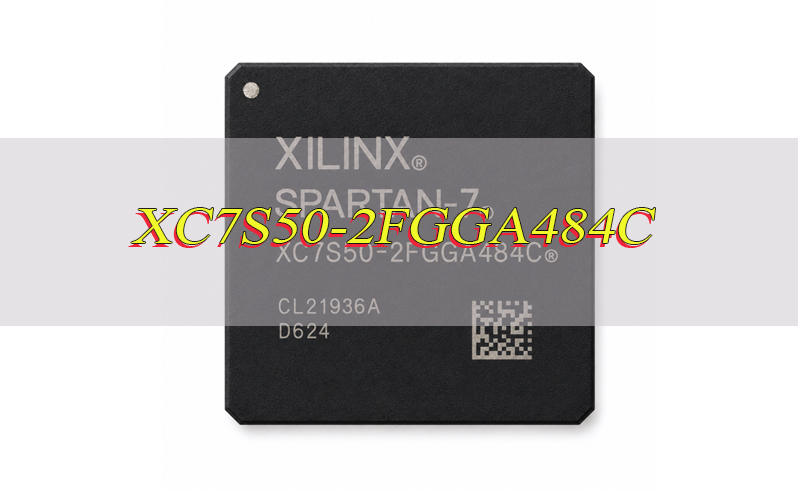
How Can You Confirm You Are Buying the Correct XC7S50-2FGGA484C?
Start with the complete ordering code. For an existing design, do not approve a component based only on “XC7S50” or the fact that it uses a similar 484-ball package.
| Specification | XC7S50-2FGGA484C | What to Confirm |
|---|---|---|
| Device | XC7S50 | Correct Spartan-7 device |
| Speed grade | -2 | Must match the approved timing requirement |
| Package | FGGA484 | Must match the approved package and PCB design |
| Package size | 23 × 23 mm | Physical package confirmation |
| Ball pitch | 1.0 mm | Relevant to PCB footprint compatibility |
| Maximum user I/O | 250 | Device/package capability |
| Temperature grade | C | Commercial temperature grade |
In the ordering code, -2 is the speed grade, FGGA484 identifies the package, and C identifies the commercial temperature grade. A similar Spartan-7 device may share part of the package designation without being electrically interchangeable with XC7S50-2FGGA484C.
Before reviewing authenticity or physical condition, make sure the quotation itself lists the exact approved ordering code. If your BOM requires XC7S50-2FGGA484C, any proposed substitute should be reviewed separately rather than accepted because the package appears similar.
What Should You Check on the XC7S50-2FGGA484C Top Marking?
First determine which marking format the device uses. Genuine 7 Series devices can appear with different top-mark formats depending on their production period, so you should not expect every genuine XC7S50-2FGGA484C to display exactly the same information on its surface.
Older or traditional marking formats may show combinations of:
- Device identification
- Package information
- date code
- lot code
- Pin 1 indicator
- 2D barcode or other traceability identifiers
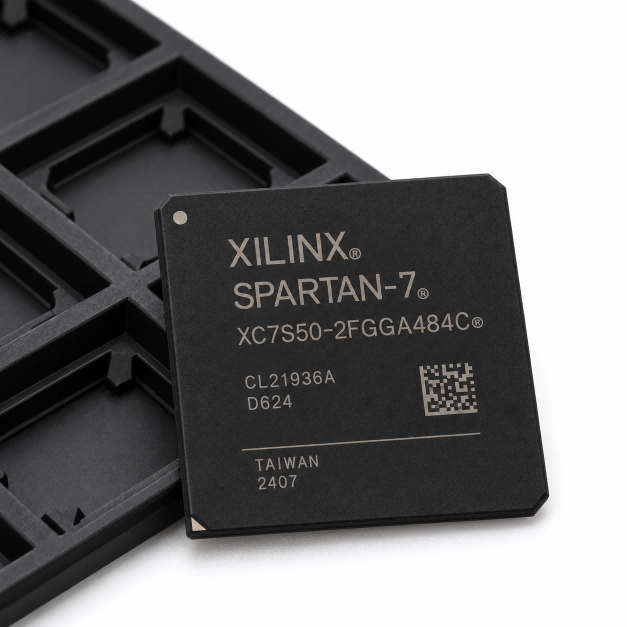
Later 7 Series production may use a simplified top marking. In this format, the package can carry a Xilinx logo, a 2D barcode, country-of-origin information, and optional family branding without printing the complete device, speed, package, and temperature information directly on the component.
Therefore, the absence of the full XC7S50-2FGGA484C ordering code on the package surface is not by itself evidence of a counterfeit device. For simplified-marking stock, the 2D barcode and corresponding packaging information become more important.
When possible, request clear photos of multiple devices rather than one isolated component. You are looking for consistency between the marking format, physical devices, packaging, and lot information—not just whether one photograph resembles an online reference image.
Which XC7S50-2FGGA484C Marking Irregularities Should Raise Concern?
Marking inspection is most useful for identifying unexplained physical inconsistencies, especially when multiple components are claimed to come from the same stock or lot.
Look more closely when you see:
- Noticeably different character shapes, spacing, or alignment among comparable devices.
- Uneven or unusual package-surface texture around marked areas.
- Possible sanding, resurfacing, or recoating on the component body.
- Large differences in laser-mark depth or sharpness between samples.
- Damaged or unusually poor-quality 2D markings.
- Pin 1 indicators that appear inconsistent across equivalent devices.
- Marking styles that differ within stock claimed to be one uniform lot without an explanation.
These signs should be treated as reasons for further investigation, not automatic proof of counterfeiting.
Production periods and marking processes can change. Comparing one XC7S50-2FGGA484C against a single internet photograph is therefore much less useful than checking whether the offered devices are internally consistent and whether their markings agree with the packaging and traceability information.
How Can You Check the XC7S50-2FGGA484C Packaging Before Purchase?
Compare the quotation, package label, moisture barrier bag or tray, and actual devices as one set of evidence. A clean label does not verify the components by itself; the information on the packaging needs to make sense together with the stock inside.
Check for:
- Exact ordering code on the quotation and available packaging records.
- date code and lot information where applicable.
- Quantity on the packaging compared with the quantity being offered.
- Bag and tray condition, particularly for older or repacked material.
- Seal integrity when material is represented as factory sealed.
- Moisture barrier packaging, desiccant, and humidity-control condition.
- Labels that appear replaced, layered, altered, or unrelated to the contents.
Packaging condition also matters after authenticity screening. FGGA484 is a JEDEC MSL 3 package, so opened or repacked stock requires proper moisture handling before reflow.
If the original moisture barrier packaging has been opened, do not judge assembly readiness from the external appearance of the FPGA alone. Ask what moisture-control history is available and determine whether your assembly process requires baking or other handling according to your manufacturing procedure.
How Should You Verify the Date Code and Lot Code on XC7S50-2FGGA484C?
Use the date code and lot code as cross-checking information, not as standalone authenticity tests.
A practical process is:
- Record the actual date code and lot code available for the offered stock.
- Compare multiple devices when the supplier claims one lot.
- Cross-check device information with packaging information.
- State your acceptable date range before ordering if your project has one.
- Specify one-lot requirements before purchase if qualification or traceability depends on them.
An older date code does not automatically make XC7S50-2FGGA484C unusable. Likewise, mixed date codes do not automatically mean the stock is counterfeit.
For many projects, storage condition, moisture control, traceability, physical condition, and electrical performance are more relevant than age alone. The important point is that mixed lots or date codes should be disclosed before you approve material when your purchasing specification restricts them.
Do not accept descriptions such as “new date code” or “recent DC” when a defined date range matters to the project. Ask for the actual information associated with the offered stock.
How Can You Confirm the Inspection Evidence Belongs to the XC7S50-2FGGA484C Lot You Will Receive?
This is one of the most important checks when buying from available market stock. A genuine-looking sample or inspection report is useful only when you can connect it to the material that will actually be shipped.
Follow the evidence from purchase to shipment:
Step 1: Match the quotation to the offered stock.
Confirm the exact XC7S50-2FGGA484C ordering code, quantity, date code requirement, lot requirement, and packaging condition.
Step 2: Match stock photos to the packaging.
Useful photos should show the devices together with identifiable tray, bag, or label information whenever possible.
Step 3: Match inspection samples to the offered lot.
If samples undergo visual inspection, X-Ray, De-Cap, or functional testing, confirm which lot or stock group those samples represent.
Step 4: Match the approved lot to the shipment.
If the available quantity changes or the order needs to be filled from another lot, the new material should be reviewed against the original requirements again.
This prevents a common verification gap: approving one sample or photograph without knowing whether the production quantity comes from the same stock.
Website inventory, quotation quantity, photographs, test reports, and shipment records should refer to the same material whenever they are being used as evidence for your purchasing decision.
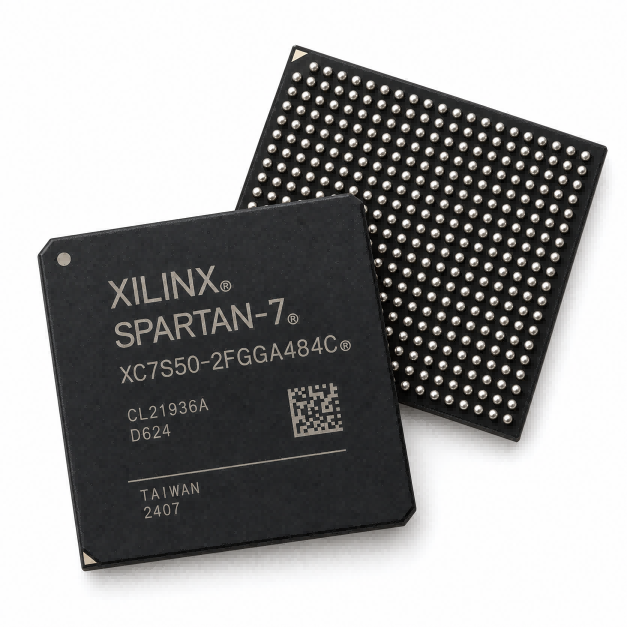
What Physical Signs Should You Check on XC7S50-2FGGA484C?
Ask for clear top-side, edge, and BGA-side photographs, particularly for higher-value orders, older stock, or material with limited sourcing history.
Check for:
- Scratches, abrasion, or unusual surface texture on the package body.
- Residue or contamination around package edges.
- Oxidation or other storage-related contamination.
- Chipped corners or mechanical damage.
- Missing, flattened, irregular, or damaged BGA balls.
- Large differences in ball appearance among devices represented as equivalent stock.
- Evidence consistent with previous mounting, removal, or reballing.
The BGA side deserves particular attention because previous board removal or rework may leave physical evidence even when the top side appears clean.
However, clean and uniform BGA balls do not prove that a device is unused or genuine. Skilled rework can produce parts that appear convincing in normal photographs. Visual inspection should therefore be treated as a screening method rather than final proof.
If visual evidence leaves significant questions unanswered, use those specific concerns to determine whether additional testing is worthwhile.
When Should X-Ray or De-Cap Testing Be Used for XC7S50-2FGGA484C?
Use deeper inspection when the order value, sourcing uncertainty, production risk, or unexplained visual evidence justifies it. Not every order needs every test.
| Method | What It Can Help Check | Main Limitation |
|---|---|---|
| X-Ray | BGA structure, possible rework, internal consistency, sample-to-sample anomalies | Does not establish complete sourcing history |
| De-Cap | Die-level identification and internal examination | Destructive to the tested sample |
X-Ray inspection is non-destructive. It can help reveal structural differences, suspicious BGA work, or inconsistencies between components that appear similar externally.
De-Cap testing physically opens the package so the die can be examined. Because the tested FPGA is destroyed, this method is generally more appropriate for higher-value or higher-risk purchases where deeper verification is worth sacrificing a sample.
The purpose is not to order every available test. Choose the inspection method according to the risk that remains unresolved. If traceability and visual inspection already provide sufficient evidence for a low-risk prototype purchase, destructive testing may add little value. For a large production order with uncertain sourcing history, the decision may be different.
How Can Functional Testing Help Verify XC7S50-2FGGA484C?
Functional testing answers a narrower but important question: does the device operate correctly within the scope of the test that was actually performed?
Depending on the available fixture and project requirements, testing may include:
- Device recognition or identification
- JTAG communication
- Configuration or programming behavior
- Selected I/O operation
- Application-specific electrical or functional checks
The exact scope should be documented. A device that can be recognized and programmed has passed those checks, but that result does not automatically verify every I/O, logic resource, memory function, or timing condition.
In particular, a basic programming test should not be interpreted as proof of full -2 speed-grade timing performance unless the test setup and acceptance criteria actually verify the required timing characteristics.
Before relying on a report, confirm what was tested, how many samples were tested, which lot the samples came from, and what pass/fail criteria were used.
Functional testing complements marking, packaging, physical inspection, and traceability. It does not replace them.
What Should You Include in an XC7S50-2FGGA484C RFQ?
A clear RFQ makes it easier to compare offers and prevents important requirements from being discussed only after a quotation has been issued.
Include:
- Exact part number: XC7S50-2FGGA484C
- Required quantity
- Acceptable date code range, if restricted
- One-lot requirement, if required
- Packaging requirement, including factory-sealed material if necessary
- Required stock photographs or label photographs
- Visual inspection requirements
- X-Ray, De-Cap, or functional testing requirements, if applicable
- Acceptance criteria for any requested testing
- Delivery location and required delivery date
If substitutions are not acceptable, state no substitution clearly rather than assuming similar Spartan-7 devices will be rejected automatically.
For larger or production-critical orders, also ask whether the quoted quantity comes from one identifiable stock group or several lots. That question should be answered before you approve inspection samples.
FAQs About XC7S50-2FGGA484C
Q1: Can a genuine XC7S50-2FGGA484C have only a 2D barcode on the top?
A1: Yes. Later 7 Series production can use simplified top marking, so a genuine device may not show the complete device, package, speed grade, date code, and lot code directly on its surface. In that situation, the 2D barcode and corresponding packaging information should be used for verification.
Q2: Does another Spartan-7 FPGA in an A484 footprint directly replace XC7S50-2FGGA484C?
A2: Not automatically. Some Spartan-7 devices with the same A484 footprint identifier are footprint compatible, but footprint compatibility is not the same as complete electrical or design compatibility. Logic resources, I/O use, timing, power, configuration, and the implemented FPGA design still need to be reviewed.
Q3: Can XC7S50-2FGGA484I replace XC7S50-2FGGA484C?
A3: The package and device family may be closely related, but the temperature-grade difference must be reviewed against your approved BOM and qualification requirements. Do not substitute the commercial and industrial variants solely because the physical package is the same.
Q4: Is a very low XC7S50-2FGGA484C price proof that the parts are counterfeit?
A4: No. Price can be affected by quantity, inventory age, market availability, sourcing channel, and the seller’s position. A quotation that is unusually different from other offers is a reason to request stronger evidence, not proof by itself.
Q5: Should I request a sample before ordering a large quantity?
A5: It can be useful when the purchase value or sourcing risk is significant. Make sure the sample can be tied to the same stock or lot intended for the production order; otherwise, testing the sample provides limited evidence about the final shipment.
Q6: What documents should I keep after purchasing XC7S50-2FGGA484C?
A6: Keep the quotation, purchase requirements, stock photographs, packaging and label images, date code and lot information, inspection reports, testing records, and shipment documentation. Keeping these records together helps with repeat orders, traceability, incoming inspection, and later failure analysis.
Q7: Does passing a programming test prove that XC7S50-2FGGA484C is fully functional?
A7: No. It proves only the functions covered by that test. Programming success does not automatically verify every I/O, timing path, memory resource, or application-specific function.
Q8: Should older-date-code XC7S50-2FGGA484C automatically be rejected?
A8: Not necessarily. Age alone does not determine whether the FPGA is suitable. Review storage history, moisture control, packaging condition, traceability, physical condition, and the electrical requirements of your project.
Q9: What should I do if the approved sample and production lot are different?
A9: Review the new lot again before shipment. A sample inspection only supports the stock that the sample represents. If the supplier changes lots, date codes, or source material, verify that the replacement stock still meets the agreed requirements.
Q10: Should XC7S50-2FGGA484C be checked again on a repeat order?
A10: Yes. A repeat purchase can come from a different lot, production period, packaging condition, or sourcing history. Previous successful deliveries do not verify new stock automatically.
Conclusion
Before buying XC7S50-2FGGA484C, make sure you are verifying the actual stock you will receive, not just a part number listed on a website. Check whether the marking, packaging, date code, lot code, physical condition, and available inspection records all point to the same material. If the order is high-value, production-critical, or has limited traceability, additional X-Ray, De-Cap, or functional testing can give you more evidence before you commit to the purchase.
If you need XC7S50-2FGGA484C now, Melson Components has stock available. You can ask for the current lot information, date code details, stock photos, packaging condition, and available inspection or testing options before placing your order. Send your required quantity, date code requirement, testing requirement, and delivery location to sales@melsonchip.com for current availability and pricing.