 English
 中文
中文  english
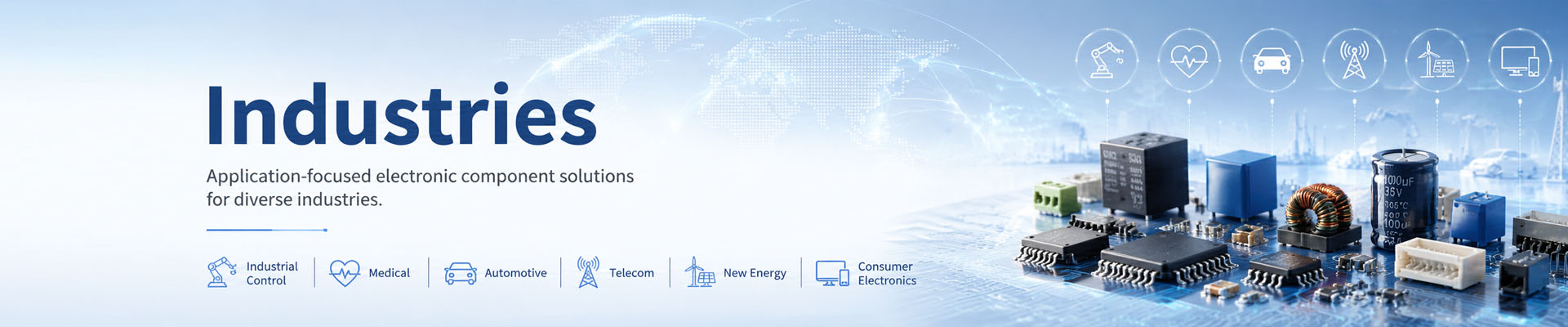
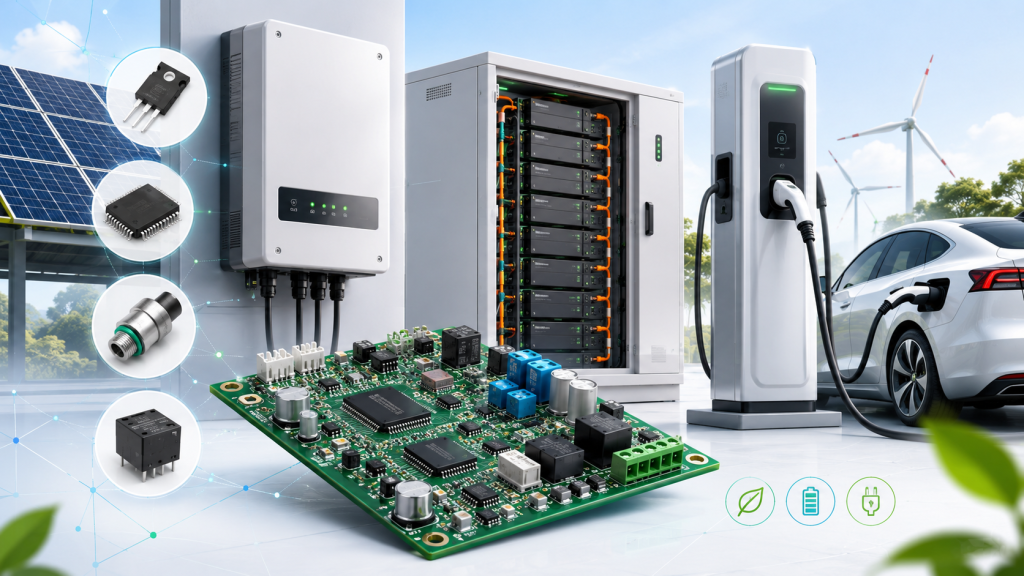
New energy projects rely on stable power conversion, safe energy storage, efficient charging, and long-term component reliability. Whether the product is used in solar inverters, energy storage systems, EV chargers, battery management systems, or power control units, one delayed or mismatched component can affect the whole production schedule. In this industry, component sourcing is not only about finding stock. It also involves lifecycle checking, electrical matching, thermal review, safety compliance, batch consistency, and alternative planning.
What Components Are Commonly Used in New Energy?
New energy electronics usually include power conversion circuits, control circuits, sensing circuits, communication modules, protection circuits, and battery-related systems. Because these products often handle high voltage, high current, and long operating hours, component selection needs careful review.
Common new energy components include:
| Component Type | Common Use in New Energy Applications |
|---|---|
| IGBTs | Power switching in inverters, converters, and motor drive systems |
| SiC MOSFETs | High-efficiency switching in EV chargers, solar inverters, and energy storage converters |
| Power MOSFETs | DC-DC conversion, battery control, power switching, and protection circuits |
| Gate Driver ICs | Driving IGBTs, SiC MOSFETs, and power MOSFETs safely and efficiently |
| MCUs and DSPs | System control, power conversion control, BMS management, and communication |
| Battery Management ICs | Cell monitoring, balancing, protection, and battery pack management |
| Current Sensors | Current measurement in charging systems, inverters, and BMS units |
| Voltage Sensors | High-voltage detection, battery pack monitoring, and system feedback |
| Isolation Components | Signal isolation, safety separation, and high-voltage system protection |
| Film Capacitors | DC-link filtering, power smoothing, and inverter applications |
| Electrolytic Capacitors | Energy storage, filtering, and power supply stabilization |
| Inductors and Transformers | Power conversion, EMI filtering, and isolated power supplies |
| Relays and Contactors | Battery connection, charging control, and high-current switching |
| Fuses and Protection Devices | Overcurrent, surge, ESD, and system protection |
| Connectors and Terminals | High-current, high-voltage, signal, and battery connections |
| Thermal Sensors | Temperature monitoring for batteries, power devices, and charging modules |
| Communication ICs | CAN, RS485, Ethernet, and other communication interfaces |
| Optocouplers and Digital Isolators | Isolation between control and power circuits |
In new energy products, components often work together as a power system. For example, a solar inverter may require IGBTs or SiC MOSFETs, gate drivers, current sensors, DC-link capacitors, isolation devices, protection parts, and control ICs. If one part is not properly selected, it may affect efficiency, thermal performance, safety margin, or long-term reliability.
What Are the Key Requirements for New Energy Components?
New energy components must support electrical stability, safety, thermal endurance, and long-term availability. Compared with many consumer electronics products, new energy systems usually have higher power levels and longer service expectations.
1. High Voltage and High Current Capability
Many new energy products work with high-voltage battery packs, DC bus systems, or grid-connected power stages. Components must be selected according to the actual voltage and current range of the system.
Important electrical factors include:
- Voltage rating
- Current rating
- Surge current capability
- Switching frequency
- Power loss
- Safe operating area
- Insulation rating
- Creepage and clearance requirements
- Short-circuit withstand capability
For power semiconductors, a small mismatch in voltage margin or thermal capacity may affect system stability under heavy load.
2. Strong Thermal Performance
Thermal management is one of the most important areas in new energy electronics. Power devices, capacitors, transformers, inductors, and relays may operate under high load for long periods.
Components should be reviewed for:
- Operating temperature range
- Junction temperature
- Thermal resistance
- Power dissipation
- Derating curve
- Heat transfer path
- Package thermal design
- Cooling method compatibility
For example, SiC MOSFETs may offer excellent switching efficiency, but the gate driving, layout, heat dissipation, and protection design still need careful matching.
3. Long Operating Life
New energy products are often expected to work for years. Solar inverters, energy storage systems, EV chargers, and battery control units need stable components with suitable lifetime support.
Lifecycle review should include:
- Manufacturer lifecycle status
- Long-term supply availability
- Authorized distributor stock
- EOL risk
- Last-time-buy notice
- Alternative source availability
- Historical supply stability
This is especially important for BMS ICs, power devices, relays, connectors, capacitors, and isolation components.
4. Safety and Compliance Support
New energy products often need to meet industry and regional safety requirements. While final certification depends on the complete product design, component documentation can support the approval process.
Useful documents may include:
- RoHS
- REACH
- UL-related documentation
- Datasheets
- Material declarations
- Reliability reports
- Original certificates
- Traceability records
- Manufacturer change notices
For high-voltage systems, isolation rating, flame resistance, insulation performance, and safety spacing should be carefully checked.
5. Batch Consistency and Traceability
Batch consistency matters in new energy production because component differences may influence performance, thermal behavior, and field reliability.
For critical parts, customers should check:
- Manufacturer label
- Date code
- Lot number
- Package condition
- Moisture sensitivity level
- Storage condition
- Test record
- Source traceability
For power devices and safety-related parts, stable sourcing and clear traceability are especially important.
What Sourcing Challenges Do New Energy Customers Face?
New energy customers often manage large, complex BOMs. These BOMs may include high-value power semiconductors, long-lead-time ICs, safety parts, high-current connectors, and customized magnetic components. As a result, sourcing can become difficult if risks are not checked early.
1. Long Lead Time for Power Devices
IGBTs, SiC MOSFETs, gate drivers, current sensors, BMS ICs, and isolated power components may have long lead times, especially when market demand rises.
This can affect products such as:
- Solar inverters
- Energy storage converters
- EV charging modules
- Battery management systems
- DC-DC converters
- Motor drive controllers
- Power control units
When one critical device is delayed, the complete assembly plan may also be delayed.
2. EOL and Product Lifecycle Risk
Some new energy products stay in production for many years. During this time, certain ICs, sensors, connectors, or protection devices may become obsolete.
Common EOL-sensitive components include:
- BMS monitoring ICs
- Gate driver ICs
- Interface ICs
- Specific relays
- Legacy MOSFETs
- Special connectors
- Certain capacitors
- Isolated communication components
If EOL checking is not done early, customers may face urgent redesign, expensive spot-buying, or delayed production.
3. Difficulty in Finding Approved Alternatives
New energy components are not always easy to replace. Even if two parts have similar ratings, they may behave differently in the actual circuit.
For example:
- A MOSFET with different gate charge may affect switching loss.
- A gate driver with different timing may affect protection behavior.
- A current sensor with different accuracy may affect BMS control.
- A relay with different contact resistance may affect heating.
- A capacitor with different ripple current rating may affect lifetime.
- A connector with different plating or contact structure may affect reliability.
Because of this, alternatives should be reviewed from both technical and supply chain perspectives.
4. Counterfeit and Gray Market Risk
High-value power semiconductors and scarce ICs can attract counterfeit or uncertain market stock. In new energy products, poor-quality components may create serious reliability concerns.
To reduce this risk, customers should use sourcing partners that can support:
- Original sourcing
- Authorized channel checking
- Visual inspection
- X-Ray inspection
- De-Cap testing when required
- Functional testing when applicable
- Full traceability records
This is especially important for power modules, MOSFETs, IGBTs, BMS ICs, and high-value control chips.
5. Cost Pressure During Mass Production
New energy products often face strong cost pressure, especially in competitive markets such as solar, energy storage, and EV charging.
However, reducing cost should not mean selecting weaker components. A better approach is to analyze the BOM and decide which parts can be adjusted safely.
A practical BOM review may check:
- Which parts are major cost drivers?
- Which parts have stable second sources?
- Which parts should not be changed?
- Which parts require engineering validation?
- Which components have better lifecycle options?
- Which parts can be replaced without PCB redesign?
This helps customers reduce cost while keeping product performance stable.
How Can Component Alternatives Help New Energy Projects?
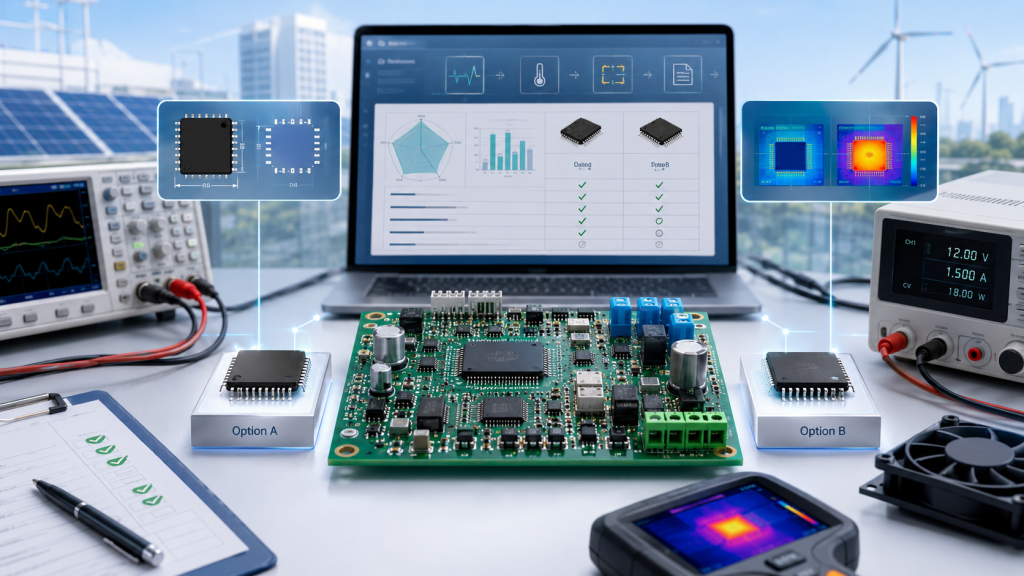
Component alternatives can help new energy customers reduce lead time pressure, control cost, extend product lifecycle, and prepare for long-term production. However, alternative selection must follow a disciplined review process.
1. Electrical Parameter Matching
The first step is to compare the electrical specifications of the original part and the replacement part.
For power devices, the review may include:
- Voltage rating
- Current rating
- RDS(on)
- Gate charge
- Threshold voltage
- Switching speed
- Reverse recovery performance
- Power dissipation
- Safe operating area
- Short-circuit capability
For control ICs and sensors, the review may include:
- Input and output range
- Accuracy
- Response time
- Interface type
- Noise performance
- Protection functions
- Reference voltage
- Communication protocol
A replacement part should be suitable for the actual circuit, not just similar on the datasheet.
2. Package and Layout Compatibility
Package compatibility is very important when the product is already in production. Even a small package difference may require PCB changes, stencil changes, thermal design changes, or new process validation.
The review should confirm:
- Package type
- Pin definition
- Pin pitch
- Land pattern
- Thermal pad structure
- Mounting method
- Height limit
- Soldering profile
- Mechanical fit
Pin-to-pin alternatives are usually preferred for repeat production. For new product development, the team may have more flexibility to adjust the design.
3. Thermal and Lifetime Review
New energy systems often run under high load and high temperature. Therefore, alternative components should be checked for thermal capacity and expected lifetime.
This review may include:
- Operating temperature
- Junction temperature
- Thermal resistance
- Ripple current rating
- Lifetime curve
- Load derating
- Cooling condition
- Field application environment
This is particularly important for capacitors, power semiconductors, relays, connectors, and magnetic components.
4. Safety and Compliance Review
For high-voltage new energy applications, safety cannot be ignored. Alternative components should meet the required safety level of the system.
Important checks may include:
- Isolation voltage
- Creepage distance
- Clearance distance
- Flame rating
- Surge capability
- Protection rating
- Certification support
- Material compliance
This helps the replacement plan stay aligned with the final product requirements.
5. Supply Chain Evaluation
A technically suitable alternative should also be easy to source over the long term. Otherwise, the customer may solve one problem today and face another problem later.
Supply chain checks may include:
- Manufacturer status
- Lifecycle stage
- Authorized distributor support
- Stock availability
- MOQ
- Lead time
- Price trend
- Future supply risk
For new energy customers with repeat orders, this step can reduce future purchasing uncertainty.
6. Sample Testing and Approval
Before mass production, important alternatives should go through sample testing.
Testing may include:
- Power-on test
- Functional test
- Load test
- Thermal test
- Charging and discharging test
- Signal test
- Protection test
- Aging test if needed
For power conversion and battery systems, board-level validation is especially important because real working conditions may reveal issues that a datasheet cannot fully show.
Case Study: How We Solved a Component Issue for a New Energy Customer
A new energy customer was preparing a production order for an energy storage control board. The board was used in a battery energy storage system and included BMS-related ICs, MOSFETs, isolated communication devices, current sensors, DC-DC converters, connectors, and protection components.
During BOM preparation, the customer found that one BMS monitoring IC had a long lead time. At the same time, a specific isolated communication component showed unstable stock. The customer needed a sourcing plan that could support production without changing the entire design.
Customer Challenge
The customer needed to solve three problems:
- Keep the current PCB layout as much as possible
- Find reliable stock for the current production batch
- Prepare alternative options for future repeat orders
Because the board was related to battery monitoring and system protection, the customer could not accept random replacement.
Our Review Process
First, we reviewed the full BOM and classified the parts by risk level.
The high-risk items included:
- BMS monitoring ICs
- Isolated communication components
- MOSFETs
- Current sensors
- DC-DC converters
- High-current connectors
- Protection devices
Then we checked the lifecycle status, stock source, lead time, package compatibility, and electrical parameters of the risky items.
For the BMS monitoring IC, we reviewed:
- Cell monitoring range
- Communication interface
- Measurement accuracy
- Protection features
- Package
- Manufacturer lifecycle status
- Available stock source
For the isolated communication component, we reviewed:
- Isolation voltage
- Data rate
- Supply voltage
- Package
- Pin compatibility
- Safety documentation
- Stock stability
Alternative Recommendation
We prepared a comparison table for the customer. It included the original part, possible alternatives, parameter differences, package information, stock status, lead time, lifecycle notes, and testing suggestions.
The customer selected one sourcing option for the current production batch and one alternative option for engineering validation.
Testing and Result
After sample testing, the selected parts met the customer’s basic functional and communication requirements. The customer completed a small trial production run and confirmed that the board could move forward without major PCB layout changes.
The result was positive:
- The customer reduced production delay risk.
- The current order received a workable sourcing plan.
- The alternative option created a backup path for future orders.
- The BOM risk became more visible before larger production.
This case shows why new energy component sourcing should combine purchasing ability with technical review. For power and battery-related systems, safe replacement planning brings more value than simple stock searching.
How Do We Support New Energy Component Sourcing?
For new energy customers, we support component sourcing from BOM review to delivery. Our goal is to help customers find suitable parts, reduce sourcing risk, and prepare better alternatives before production is affected.
1. BOM Health Analysis
We can review the BOM and identify high-risk components before purchasing starts.
Our BOM review may include:
- EOL checking
- Long lead-time review
- Single-source risk review
- High-cost component checking
- Obsolete part identification
- Alternative availability review
- Stock and delivery risk analysis
This helps customers plan earlier and avoid urgent sourcing pressure.
2. Original Component Sourcing
We support original component sourcing for new energy applications, including power devices, ICs, sensors, connectors, passives, relays, protection components, and communication parts.
For important components, we can help check:
- Manufacturer
- Part number
- Package
- Date code
- Lot number
- Stock source
- Delivery schedule
- Traceability information
3. Alternative Component Support
When original parts are unavailable, costly, or close to EOL, we can help prepare alternative options.
Our alternative support may include:
- Electrical comparison
- Package comparison
- Pinout review
- Thermal review
- Lifecycle checking
- Supply status checking
- Suggested sample testing
- Engineering notes for approval
This is especially useful for energy storage, solar inverter, EV charger, and BMS projects.
4. Obsolete and Hard-to-Find Component Sourcing
Some new energy systems still use legacy ICs, older MOSFETs, discontinued connectors, or special control chips. We can help search for obsolete and hard-to-find parts while keeping quality control in focus.
For higher-risk parts, additional inspection can be arranged.
5. Component Inspection and Testing Support
To support quality control, we can provide inspection support such as:
- Visual inspection
- X-Ray inspection
- De-Cap testing when required
- Functional testing when applicable
- Package and marking verification
- Shipment documentation review
These checks help reduce the risk of counterfeit, mixed, or poor-condition components.
6. Traceability and Delivery Control
New energy customers often need clear traceability because their products may be used in long-life and safety-related systems. We can support traceability from RFQ to shipment, including supplier source, batch information, inspection records, packaging status, and delivery details.
For urgent projects, quick response helps production continue. For long-term projects, stable supply planning helps reduce repeated sourcing problems.
FAQs About New Energy Components
Q1: What should be checked before buying components for new energy products?
A1: Buyers should check voltage rating, current rating, thermal performance, package compatibility, lifecycle status, lead time, stock source, date code, and traceability. For power and battery-related systems, safety margin and reliability should also be reviewed.
Q2: Can power components in new energy systems be replaced easily?
A2: Power components can be replaced only after careful review. Voltage, current, switching behavior, thermal performance, package, gate drive requirements, and protection behavior should all be checked before approval.
Q3: Why is lifecycle checking important for new energy components?
A3: New energy products often have long service lives. If a critical component becomes obsolete during production, it may affect future orders, maintenance, and product continuity. Early lifecycle checking helps customers prepare alternatives in advance.
Q4: Which new energy components are usually harder to source?
A4: IGBTs, SiC MOSFETs, gate driver ICs, BMS ICs, current sensors, isolated communication parts, high-voltage connectors, and specific power modules can be harder to source when demand is high or stock is limited.
Q5: How can customers reduce counterfeit risk when sourcing new energy components?
A5: Customers should work with reliable sourcing partners, request traceability records, check package and date code information, and use inspection methods such as X-Ray or De-Cap testing when needed. Functional testing is also helpful for high-value parts.
Q6: Is BOM review necessary before sourcing components for new energy projects?
A6: Yes. BOM review helps identify long lead-time parts, EOL risks, single-source items, high-cost components, and parts that may need approved alternatives. It gives customers more time to prepare before production starts.
Q7: Can one new energy BOM include alternative components?
A7: Yes, but alternative components should be reviewed and approved before production. For critical parts such as MOSFETs, BMS ICs, gate drivers, current sensors, and isolation components, sample testing is recommended.
Q8: Why is traceability important in new energy component sourcing?
A8: Traceability helps customers know where components come from, which batch was used, how the parts were inspected, and when they were shipped. This supports quality control, production records, and future failure analysis.
Ready to Source New Energy Components with More Confidence?
If you are working on a new energy project and need support with component sourcing, BOM review, EOL checking, obsolete parts, or alternative component selection, our team can help you reduce sourcing pressure and move faster toward production.
We support new energy customers with original component sourcing, qualified supplier channels, alternative part analysis, inspection support, and traceability management. Whether your project involves solar inverters, energy storage systems, EV chargers, BMS boards, power control units, or battery-related electronics, we can help you find suitable components and reduce sourcing risks before they affect production.
Send us your BOM today, and our team will help review availability, lead time, lifecycle risk, and possible alternatives.
Contact us: sales@melsonchip.danyupcbs.com