 English
 中文
 english


EP4CE15F17C8N is an Altera Cyclone IV E FPGA used in embedded control, industrial electronics, and signal-processing systems. For an existing BOM, the challenge is not simply finding the correct part number. Buyers also need a reliable source, acceptable date codes, and a delivery commitment that matches their production schedule.
A competitive quotation can quickly lose its value if the offered components come from unidentified lots or require additional verification. Understanding these sourcing risks helps buyers avoid purchasing mistakes without paying for unnecessary inspections or engineering changes.
What Is EP4CE15F17C8N?
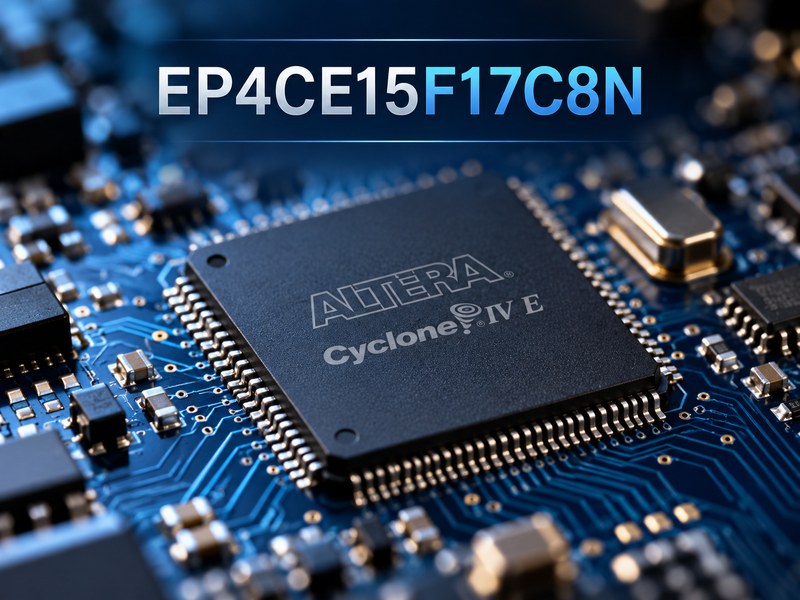
EP4CE15F17C8N is a field-programmable gate array (FPGA) belonging to Altera’s Cyclone IV E family. It provides programmable digital logic for embedded controllers, industrial equipment, communication interfaces, and signal-processing applications.
Unlike a fixed-function integrated circuit, an FPGA can implement different hardware functions through its configuration. Equipment manufacturers use this flexibility to develop application-specific control and interface functions without producing a dedicated ASIC.
For an established product, EP4CE15F17C8N is a specific component identity. Although other Cyclone IV E devices may offer similar resources, differences in package, timing, or temperature grade can prevent them from being used as direct replacements.
What Are the Key EP4CE15F17C8N Specifications?
EP4CE15F17C8N provides 15,408 logic elements, 504 Kbits of embedded memory, 56 embedded multipliers, and up to 165 user I/O pins in the F256 package.
| Specification | EP4CE15F17C8N Value |
|---|---|
| Manufacturer | Altera |
| FPGA Family | Cyclone IV E |
| Logic Elements | 15,408 |
| Embedded Memory | 504 Kbits |
| 18 × 18 Multipliers | 56 |
| Maximum User I/O (F256) | 165 |
| PLLs | 4 |
| Package | 256-pin FineLine BGA (F256) |
| Package Dimensions | 17 × 17 mm |
| Ball Pitch | 1.0 mm |
| Speed Grade | -8 |
| Temperature Grade | Commercial, 0°C to 85°C junction temperature |
| Lead-Free Packaging | N suffix |
The ordering code combines the device family and density (EP4CE15), package designation (F17), commercial temperature and speed grade (C8), and lead-free packaging suffix (N).
These characters identify the exact ordered version. A supplier offering EP4CE15F17C7N or EP4CE15F17C8 without the final N is quoting a different ordering code, even though the devices belong to the same family.
Is EP4CE15F17C8N Still in Production?
Altera lists EP4CE15F17C8N as In Production as of October 30, 2026. This confirms its published manufacturing lifecycle status, but does not establish how much inventory is available for immediate purchase.
Stock can be distributed across authorized channels, independent distributors, and different manufacturing lots. Consequently, the quantity displayed on a supplier website may not represent one available, traceable shipment.
A supplier advertising 1,000 units might have only 300 units available from a confirmed source, with the balance dependent on incoming material. If the customer requires a single lot or a restricted date-code range, the usable quantity may be lower.
For repeat production, the supply position matters beyond the first order. Buyers need to establish whether the required quantity can be secured on the agreed schedule and whether additional material is likely to be available for subsequent builds.
What Should Buyers Check Before Accepting an EP4CE15F17C8N Quote?
An EP4CE15F17C8N quotation must match the approved part number, purchasing requirements, and actual delivery conditions. Price alone cannot establish whether an offer is suitable for production.
| Quotation Item | Required Confirmation | Potential Purchasing Risk |
|---|---|---|
| Part Number | Complete EP4CE15F17C8N ordering code | Missing suffix or unapproved substitute |
| Quantity | Supplier-confirmed available quantity | Stock quantity cannot be verified |
| Supply Source | Identified and acceptable sourcing channel | Undisclosed or inconsistent source |
| Date Code | Manufacturing date range meets requirements | Unspecified or unacceptable date code |
| Price | Unit price, currency, and applicable charges | Incomplete commercial terms |
| Delivery | Agreed delivery date and shipping terms | Unconfirmed or unsuitable delivery schedule |
| Substitution | Alternatives clearly identified for approval | Different OPN supplied without authorization |
For independent-market purchases, the supplier’s ability to identify the source is especially important. A lower quotation from an unknown channel may require additional inspection or documentation that changes the overall purchasing cost.
A supplier may also quote the correct component while relying on several different inventory sources. Where date-code consistency or a single-lot shipment is required, those conditions need to be reflected in the offer rather than resolved after the order is placed.
The most useful quotation provides a clear commercial basis for the actual material offered, including any unresolved supply conditions.
How Can Buyers Verify EP4CE15F17C8N Date Codes and Authenticity?
EP4CE15F17C8N authenticity verification combines physical inspection, lot traceability, and risk-based testing. Each check addresses a different potential issue, so the inspection scope depends on the source and condition of the supplied components.
- Component Markings: Compare the part number, top markings, package appearance, and surface condition with appropriate manufacturer references. Inconsistent fonts, altered markings, resurfacing, or unexplained damage can indicate that further investigation is needed.
- Date Code Verification: Confirm that the manufacturing date codes meet the customer’s requirements. Different date codes are not automatically unacceptable, but mixed-date material must be permitted by the purchase conditions and remain traceable.
- Lot Identification: Match component markings and available manufacturer labels with the lot information supplied. A single-lot declaration should be consistent with the physical material and supporting records.
- Source Traceability: Review the available purchasing, supplier, and shipment records to establish the material’s supply history. A certificate without a clear connection to the actual components offers limited assurance.
- Visual and X-ray Inspection: Visual inspection can identify external marking and package abnormalities, while X-ray can reveal internal structural differences when compared with suitable reference material. Neither method alone proves complete authenticity.
- De-Cap and Functional Testing: De-Cap analysis can support higher-risk investigations by exposing internal die features. Functional testing checks selected electrical characteristics under defined conditions. Both methods require appropriate procedures, equipment, and acceptance criteria.
- Lot Acceptance: Material with consistent identification, acceptable traceability, and satisfactory inspection results may be released under the agreed quality plan. Unresolved marking conflicts, suspected remarking, or unacceptable test findings require additional investigation or rejection.
Inspection depth should match the purchasing risk. A well-documented lot from a known source may not need destructive testing, while material with uncertain history or suspicious markings may justify more extensive verification.
For production-critical components, the strongest evidence is tied to the actual delivered lot rather than a generic test report or a sample from unrelated inventory.

Which EP4CE15F17C8N Alternative Parts Can Be Considered?
EP4CE15F17C7N, EP4CE15F17C6N, and EP4CE15F17I7N are potential alternatives for engineering evaluation, but none is automatically interchangeable with EP4CE15F17C8N.
| Alternative Part Number | Main Difference | Required Evaluation |
|---|---|---|
| EP4CE15F17C7N | Commercial temperature grade, -7 speed grade | Timing compatibility and engineering approval |
| EP4CE15F17C6N | Commercial temperature grade, -6 speed grade | Timing validation and BOM approval |
| EP4CE15F17I7N | Industrial temperature grade, -7 speed grade | Operating-temperature and timing qualification |
| EP4CE15F17C8 | Different ordering code without N suffix | Packaging material declaration, compliance, and BOM review |
The -6 and -7 speed grades are faster than -8 within the Cyclone IV E speed-grade convention. However, the speed difference does not by itself establish compatibility with the original FPGA design.
An alternative must satisfy the approved package and pin configuration, I/O-bank requirements, timing constraints, power conditions, and applicable product qualifications.
The version without the N suffix also needs its exact material and compliance information confirmed. The missing suffix alone is not sufficient evidence of a particular material composition.
For an established design, retaining the original EP4CE15F17C8N avoids unnecessary qualification work when acceptable supply is available. Any proposed replacement must receive customer engineering approval before becoming an approved BOM item.
What Affects EP4CE15F17C8N Price and Lead Time?
EP4CE15F17C8N price and lead time depend on purchase quantity, confirmed availability, source conditions, and the customer’s acceptance requirements.
Small orders may be fulfilled from available distributor inventory, while larger production quantities can require procurement from multiple sources or additional lead time. Restricting supply to a specific date-code range or single manufacturing lot can further reduce the qualifying inventory.
Inspection requirements also affect cost. Standard visual checks and documentation review differ from specialized X-ray analysis, destructive testing, or customer-specific functional screening. The required scope depends on material risk and the customer’s quality expectations.
International freight, shipment urgency, and delivery destination can add to the total landed cost. A lower unit price may therefore offer little advantage if the material requires expensive verification or cannot arrive before the production deadline.
Melson Components reviews quantity, date-code restrictions, and delivery requirements when evaluating available sourcing options, allowing customers to compare quotations against the conditions that matter to their order.
Why Choose Melson Components for EP4CE15F17C8N Sourcing?
Melson Components is an independent electronic component distributor supporting OEMs, EMS providers, and electronics manufacturers with component sourcing, quality inspection, and traceability services.
For EP4CE15F17C8N purchases, customers can access the following support:
- Component and BOM Sourcing: We search our supplier network for the required FPGA and other electronic components, helping customers manage shortages and reduce the time spent coordinating multiple sources.
- Authenticity Inspection: Our inspection capabilities include Visual Inspection, X-ray, De-Cap, and Functional Testing. The agreed inspection scope is selected according to the component condition, supply risk, and customer requirements.
- 15-Year Traceability Records: We retain sourcing, inspection, packing, and shipment records for 15 years, providing supporting information for subsequent quality reviews and investigations.
- Shortage and Alternative Sourcing: When the required ordering code is difficult to obtain, we investigate additional supply options and provide candidate part information for customer engineering evaluation.
- Free BOM Health Check: We review BOMs for lifecycle changes, EOL risks, availability concerns, and potential sourcing problems before they disrupt purchasing or production.
Welcome to contact us if you have any request for EP4CE15F17C8N components: sales@melsonchip.com.
FAQs About EP4CE15F17C8N
Q1: Does EP4CE15F17C8N retain its configuration after power is removed?
A1: No. Cyclone IV E FPGAs use volatile SRAM configuration memory. The configuration must be loaded again when the device powers up.
Q2: Can EP4CE15F17C8N be configured through JTAG?
A2: Yes. The device supports JTAG configuration. The board must provide the appropriate JTAG connections and programming arrangements.
Q3: Does EP4CE15F17C8N include high-speed serial transceivers?
A3: No. Cyclone IV E devices do not include the integrated high-speed serial transceivers found in the Cyclone IV GX family.
Q4: Can EP4CE15F17C8N interface with DDR2 SDRAM?
A4: Yes. The Cyclone IV E family supports DDR2 SDRAM interfaces. Actual compatibility depends on the memory interface implementation, selected pins, and timing requirements.
Q5: Does EP4CE15F17C8N support LVDS signals?
A5: Yes. Cyclone IV E devices support LVDS interfaces, subject to the package’s available differential pins, I/O-bank assignments, and electrical requirements.
Q6: Can EP4CE15F17C8N use 3.3 V I/O signals?
A6: Yes. The Cyclone IV E family supports 3.3 V LVTTL/LVCMOS I/O standards in suitable I/O banks. The board’s bank supply and interface requirements must be compatible.
Q7: How many I/O banks does EP4CE15F17C8N have?
A7: The EP4CE15 device has eight I/O banks. Each bank’s supported functions and pin assignments depend on the package and relevant electrical constraints.
Q8: Does EP4CE15F17C8N contain a dedicated PCI Express hard IP block?
A8: No. Cyclone IV E devices do not include the dedicated PCI Express hard IP blocks available in certain Cyclone IV GX devices.
How Can You Request an EP4CE15F17C8N Quote?
To request an EP4CE15F17C8N quotation, provide the full part number, required quantity, date-code requirement, and delivery location. Include the target delivery date and any source, lot, or inspection restrictions that affect acceptance.
For multi-component projects, customers can also submit a BOM to identify additional sourcing needs and availability concerns.
Need EP4CE15F17C8N for your next production order? Contact Melson Components at sales@melsonchip.com with your purchasing requirements. Our team can review available sourcing options, confirm order-specific commercial conditions, and arrange component verification where required, helping you obtain the right FPGA with reliable sourcing information.