 English
 中文
中文  english

For medical device manufacturers, Medical Electronics component alternatives are not about finding a similar part as quickly as possible. Medical electronics projects often need stable components, consistent batches, and long term supply support. A single unavailable power management IC, an EOL sensor, or a long lead time connector can delay prototype validation, pilot production, or mass production.
In some cases, the design itself is ready, but one critical part in the BOM stops the entire production plan. They require a controlled process that combines BOM review, engineering comparison, supplier qualification, quality inspection, and traceability. The goal is simple: solve supply risk while keeping product reliability, performance, and production continuity under control.
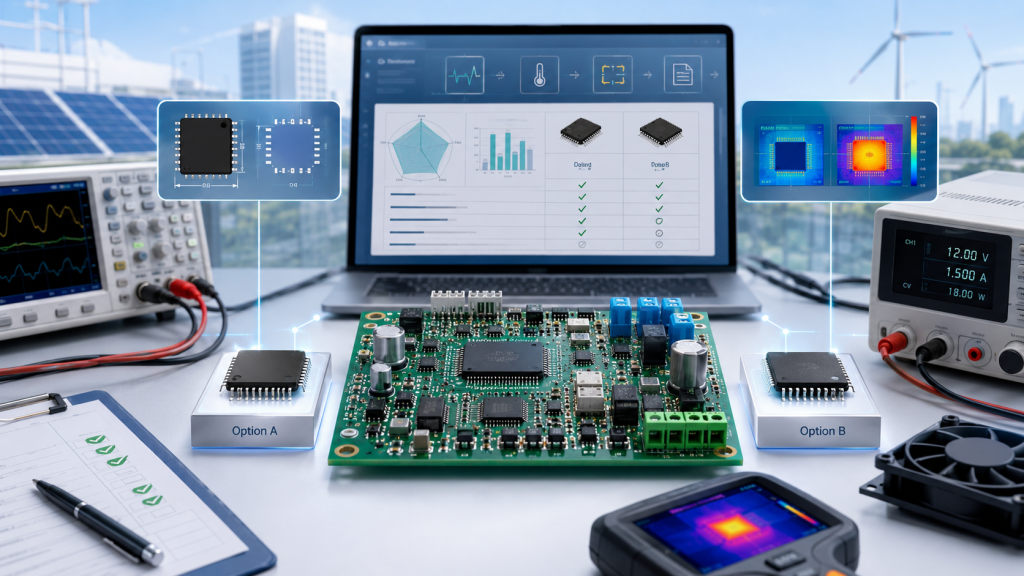
Why Are Component Alternatives Important for Medical Electronics?
Medical electronics products often have longer lifecycles than ordinary consumer electronics. Once a design enters production, manufacturers usually prefer to keep the BOM stable for years. However, the component market does not always remain stable. Parts may become short in supply, move into EOL status, or become difficult to purchase from reliable channels.
Component alternatives become important when:
- The original part is EOL or NRND.
- Lead time becomes too long for production.
- Authorized stock becomes unstable.
- Price fluctuation affects production cost.
- A component has limited supplier sources.
- The project needs a second source for long term supply.
- The original BOM uses an outdated or hard to source part.
In medical electronics, the purpose of using alternatives is not to reduce cost at the expense of reliability. The real purpose is to maintain stable production while protecting product function, consistency, and traceability.
A qualified replacement should support the same application requirements, fit the existing design as much as possible, and pass the customer’s engineering and quality approval process.
What Components Often Need Alternatives in Medical Electronics?
Medical electronics products use a wide range of electronic components. Some parts are relatively easy to replace, while others require detailed technical validation. The more closely a part is connected to measurement accuracy, signal stability, power safety, or firmware, the more carefully it should be reviewed.
| Component Type | Common Use in Medical Electronics | Alternative Risk |
|---|---|---|
| MCU / Processor | Control, signal processing, user interface | Firmware compatibility, lifecycle risk |
| Sensor | Pressure, temperature, oxygen, flow, position sensing | Accuracy, calibration, response time |
| Power Management IC | Battery, charging, voltage regulation | Efficiency, noise, thermal performance |
| Op Amp / ADC | Signal acquisition, analog front end | Offset, noise, resolution, stability |
| Connector | Patient interface, module connection, power input | Mating reliability, mechanical fit |
| Memory IC | Data logging, firmware storage | Package, speed, endurance |
| Crystal / Oscillator | Timing and clock control | Tolerance, drift, temperature stability |
| Protection Device | ESD, surge, interface protection | Clamping voltage, leakage current |
| Passive Components | Filtering, sensing, biasing | Tolerance, temperature coefficient, voltage rating |
For example, replacing a standard resistor in a non critical pull up circuit may be straightforward. However, replacing a low noise op amp in a signal acquisition circuit requires careful review. The same applies to ADCs, sensors, power ICs, and MCUs. These components may affect accuracy, stability, power behavior, or software compatibility.
What Makes Medical Electronics Component Replacement More Sensitive?
Medical electronics component replacement is more sensitive because many products depend on stable electrical behavior over a long lifecycle. A replacement part may look acceptable in a datasheet comparison, but it still needs to match the actual application.
Important factors include:
- Electrical performance
- Accuracy and tolerance
- Noise level
- Leakage current
- Power consumption
- Thermal behavior
- Signal stability
- Long term availability
- Batch consistency
- Supplier reliability
- Traceability
- Customer approval requirements
For example, a sensor alternative may have the same interface and package, but its calibration curve or response time may differ. An ADC replacement may have the same resolution, but different noise characteristics. A connector may look mechanically similar, but the mating force, plating, or durability may not be the same.
This is why medical electronics replacements should not be selected only by part description. The application position must be understood first.
What Causes Component Replacement Needs in Medical Electronics?
Medical electronics manufacturers usually need component alternatives for several practical reasons.
Common causes include:
- EOL or NRND status
Older medical designs may still use components that are no longer recommended for new designs or have reached end of life. - Long lead time
Some ICs, sensors, and connectors may have lead times of 16 weeks, 24 weeks, or even longer. - Component shortage
When market demand increases, critical parts may become unavailable from regular channels. - Single source risk
Some BOMs rely on only one manufacturer or one exact MPN, making production vulnerable. - Outdated BOM information
Some customer BOMs include incomplete descriptions, old part numbers, or unclear manufacturer information. - Authorized stock instability
Even if a part is still active, authorized distributor stock may not support urgent or repeated production demand.
In many cases, the replacement need is not caused by a design problem. It is caused by lifecycle changes, market allocation, supplier strategy, or insufficient backup planning.
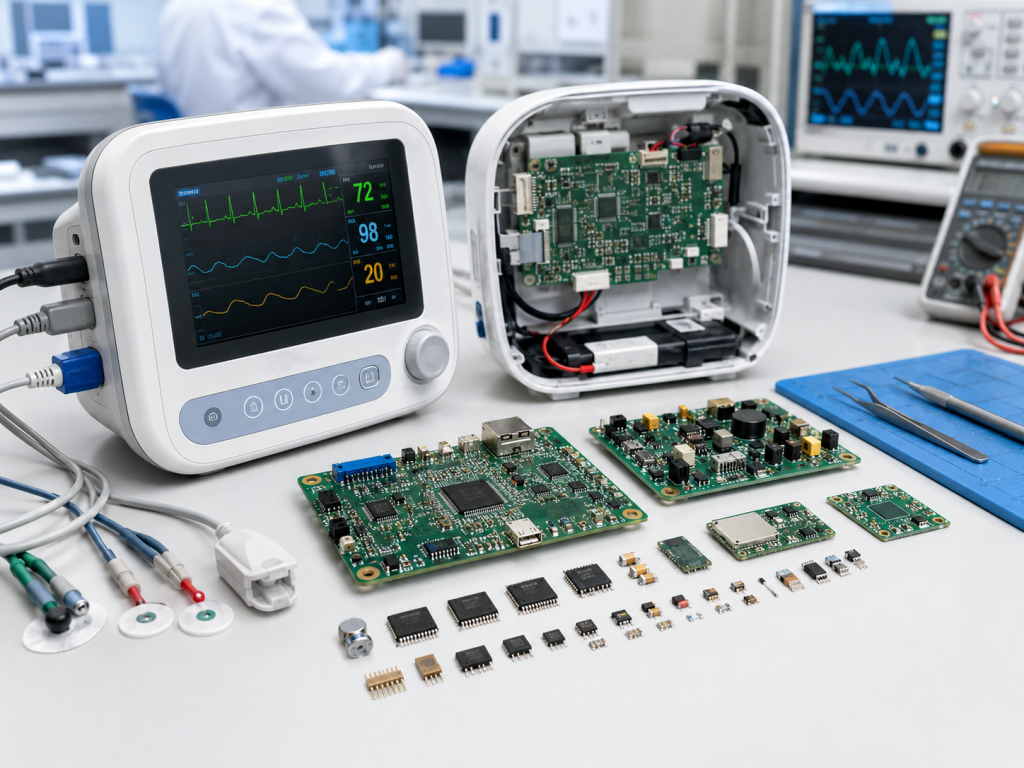
How Should a Medical Electronics BOM Be Reviewed Before Choosing Alternatives?
Before recommending alternatives, the BOM should be reviewed carefully. This step helps identify which parts are truly risky and which parts can be handled with standard sourcing.
| BOM Review Item | Purpose |
|---|---|
| Lifecycle status | Identify EOL, NRND, or last time buy risk |
| Application position | Understand whether the part affects critical function |
| Package and pinout | Avoid PCB footprint or assembly mismatch |
| Electrical parameters | Confirm functional compatibility |
| Accuracy and tolerance | Protect measurement stability |
| Supplier source | Reduce counterfeit and traceability risk |
| Alternative availability | Prepare backup sourcing options |
A practical BOM review should answer these questions:
- Is the original MPN complete and accurate?
- Is the part still active?
- Does the part have stable supply from reliable channels?
- Is it used in a critical circuit?
- Can the replacement fit the same PCB footprint?
- Does the replacement require firmware, layout, or test changes?
- Are there second source options available?
- Does the customer need formal approval before using alternatives?
After review, components can be classified into different risk levels:
- Low risk: standard passive components with many approved equivalents.
- Medium risk: connectors, protection devices, crystals, and selected power parts.
- High risk: MCU, sensor, ADC, analog front end, memory, PMIC, and special medical grade components.
This risk classification helps the sourcing team focus on the components that may delay production or affect product performance.
How Do We Evaluate Alternative Components for Medical Electronics?
Alternative evaluation should follow a structured process. The suitable replacement path depends on component type, application position, supply status, and customer approval requirements.
Drop In Alternatives
Drop in alternatives have the same package, same pinout, and very close electrical parameters. They are usually suitable for selected resistors, capacitors, diodes, TVS devices, crystals, and some protection components. Even for these parts, voltage rating, tolerance, temperature coefficient, and lifecycle should still be checked.
Same Series Alternatives
Same series alternatives are often useful for MCUs, memory ICs, and power ICs. For example, a different memory size in the same MCU family may reduce redesign pressure. However, Flash, RAM, peripheral interfaces, operating voltage, and firmware compatibility must be reviewed.
Cross Brand Alternatives
Cross brand alternatives can help when the original manufacturer has limited stock or long lead time. This approach requires careful datasheet comparison and supplier review. It should not rely only on online cross reference results.
Redesign Based Alternatives
When the original part is obsolete, unavailable, or too risky for long term production, redesign may be the better option. This can involve PCB layout changes, firmware updates, circuit adjustment, or new validation testing. For medical electronics, redesign may take more time, but it can provide a safer long term supply path.
What Parameters Must Be Checked Before Approving a Replacement?
Before approving a replacement component, both engineering and sourcing factors should be checked.
Important technical parameters include:
- Package and footprint
- Pinout
- Operating voltage
- Current rating
- Power consumption
- Temperature range
- Tolerance
- Noise level
- Leakage current
- Accuracy
- Response time
- Frequency stability
- Communication interface
- Firmware compatibility
- Thermal performance
Important supply chain factors include:
- Lifecycle status
- Manufacturer reputation
- Authorized or qualified source
- Available stock
- Lead time
- MOQ
- Date code
- Batch consistency
- Traceability documents
- Long term supply possibility
For medical electronics, low noise, high stability, measurement accuracy, and traceability often matter more than a small price difference. A cheaper component may create higher validation cost if it introduces uncertainty.
How to Reduce Quality and Counterfeit Risk During Component Replacement?
During shortage periods, unknown sources may appear with attractive prices or fast delivery. For medical electronics, this can create serious sourcing risk. Reliable replacement work should include supplier screening and inspection when needed.
| Inspection Method | Purpose |
|---|---|
| Visual Inspection | Check marking, label, package, and surface condition |
| X Ray Inspection | Check internal structure and bonding consistency |
| De Cap Inspection | Verify die structure for high risk ICs |
| Functional Testing | Confirm basic electrical performance |
| Traceability Review | Confirm source, batch, and shipment record |
| Packaging Review | Check reel, label, moisture barrier bag, and date code |
High risk components such as MCU, ADC, sensor, PMIC, memory IC, and special analog ICs should receive closer attention. A complete record from RFQ to shipment also helps the customer manage future quality reviews and batch tracking.
The goal is not just to find available stock. The goal is to find components that are technically suitable, traceable, and reliable enough for the project.
Case Study: Replacing an EOL Component for a Medical Electronics Customer
Customer Background
A medical electronics manufacturer was preparing pilot production for a portable patient monitoring device. The product included:
- 1 main control board
- 1 sensor interface board
- 1 power management board
- About 280 BOM line items
- Planned pilot run quantity: 800 sets
The prototype had passed functional testing, but the customer found that one analog front end IC and one power management IC had become difficult to source.
Challenge
During sourcing review, three issues were found:
- The analog front end IC was marked as NRND.
- The power management IC had a lead time of 20 weeks.
- Two precision passive components had unstable supply from regular distributors.
If no backup solution was prepared, the pilot run could be delayed by at least 6 to 8 weeks.
Our Solution
Our team reviewed the full BOM and identified 7 high risk components. We checked lifecycle status, supplier availability, package, pinout, electrical parameters, and application position.
For the analog front end IC, we prepared two candidate alternatives and compared:
- Input noise
- Offset voltage
- Gain accuracy
- Interface compatibility
- Package
- Supply voltage
- Long term availability
For the power management IC, we searched for same function alternatives with suitable input range, output current, efficiency, thermal behavior, and package compatibility.
For high risk components, we also checked supplier sources and recommended traceability review, packaging inspection, and X Ray inspection before shipment.
Result and Customer Satisfaction
The customer received samples within 12 working days. After engineering review, one analog front end alternative and one power IC alternative were approved for pilot production.
The project achieved these results:
- 7 high risk components were identified before production.
- 3 candidate alternatives were submitted for review.
- Lead time risk was reduced from 20 weeks to about 4 weeks.
- The 800 set pilot run was completed without changing the main PCB layout.
- A backup BOM was created for future production.
The customer was satisfied because the solution addressed both the urgent shortage and the long term supply risk. Instead of solving only one purchasing problem, the project gained a clearer component risk control plan.
How Can Long Term Supply Planning Help Medical Electronics Projects?
Long term supply planning is especially important for medical electronics because many products remain in production for years. A one time shortage solution may solve today’s issue, but it may not protect the next production batch.
A practical long term plan may include:
- Building an AVL for critical components.
- Preparing second source options.
- Checking EOL, PCN, and ECN updates regularly.
- Reviewing long lead time parts before pilot production.
- Keeping safety stock for high risk components.
- Creating a backup BOM for mass production.
- Keeping traceability records for approved components.
- Reviewing supplier performance over time.
- Preparing last time buy plans for EOL parts.
When alternative components are reviewed early, customers can reduce emergency purchasing pressure. Engineering teams also have more time to validate replacement parts properly.
Why Choose Us for Medical Electronics Component Alternatives?
For medical electronics projects, we do not recommend alternatives only based on stock availability. We review the BOM, confirm the application position, compare technical parameters, check supplier reliability, and support traceable sourcing before the replacement is submitted for approval.
Our support can include:
- BOM health analysis
- EOL and obsolete component support
- Alternative component recommendation
- Engineering comparison
- Qualified supplier network
- Original and traceable sourcing
- X Ray inspection
- De Cap inspection
- Functional testing
- Long term supply support
- Support from prototype to mass production
For components used in monitoring devices, diagnostic modules, therapy equipment, wearable medical electronics, or sensor systems, replacement decisions should be careful and documented. A correct alternative can protect production. A poor replacement can create extra validation work and quality risk.
FAQs
Q1: Can medical electronics use alternative components?
Yes. Medical electronics can use alternative components, but the replacement must be reviewed for electrical performance, package, application position, supplier reliability, and customer approval requirements.
Q2: What is the safest way to replace an EOL component in medical electronics?
The safest way is to confirm the EOL status first, check last time buy options, review same series alternatives, compare cross brand options, and decide whether redesign is needed for long term production.
Q3: Which medical electronic components are hardest to replace?
MCUs, sensors, ADCs, analog front end ICs, power management ICs, memory ICs, and special connectors are usually harder to replace because they may affect firmware, measurement accuracy, power stability, or mechanical fit.
Q4: Can you help if our BOM only includes specifications but no MPN?
Yes. We can review the specification, package, application position, electrical requirements, and BOM context to recommend possible parts or candidate series. Critical components still need engineering confirmation.
Q5: How do you reduce counterfeit risk during component replacement?
We reduce counterfeit risk through supplier screening, traceability review, packaging inspection, visual inspection, X Ray inspection, De Cap inspection, and functional testing when needed.
Q6: Can you support long term supply for approved alternatives?
Yes. We can help build AVL options, prepare backup BOMs, monitor lifecycle risk, and support traceable sourcing for prototype, pilot run, and mass production.
Send us your BOM, target quantity, preferred brands, and delivery requirements. Our team can help review EOL risk, recommend suitable alternatives, verify supplier sources, and support traceable sourcing from prototype to mass production.