 English
 中文
中文  english

Industrial control component alternative solutions help manufacturers reduce BOM risk, solve EOL and shortage issues, and keep production moving with safer replacement options. For PLC modules, motor drives, industrial power supplies, HMI panels, sensors, instruments, and communication boards, one unavailable component can delay an entire production plan.
At Melson Electronics, we support industrial control customers with BOM health analysis, alternative component sourcing, shortage recovery, obsolete part sourcing, in-house testing, and full traceability records. Helping customers find reliable components, reduce supply chain risk, and maintain stable production from prototype to mass production is our goal.
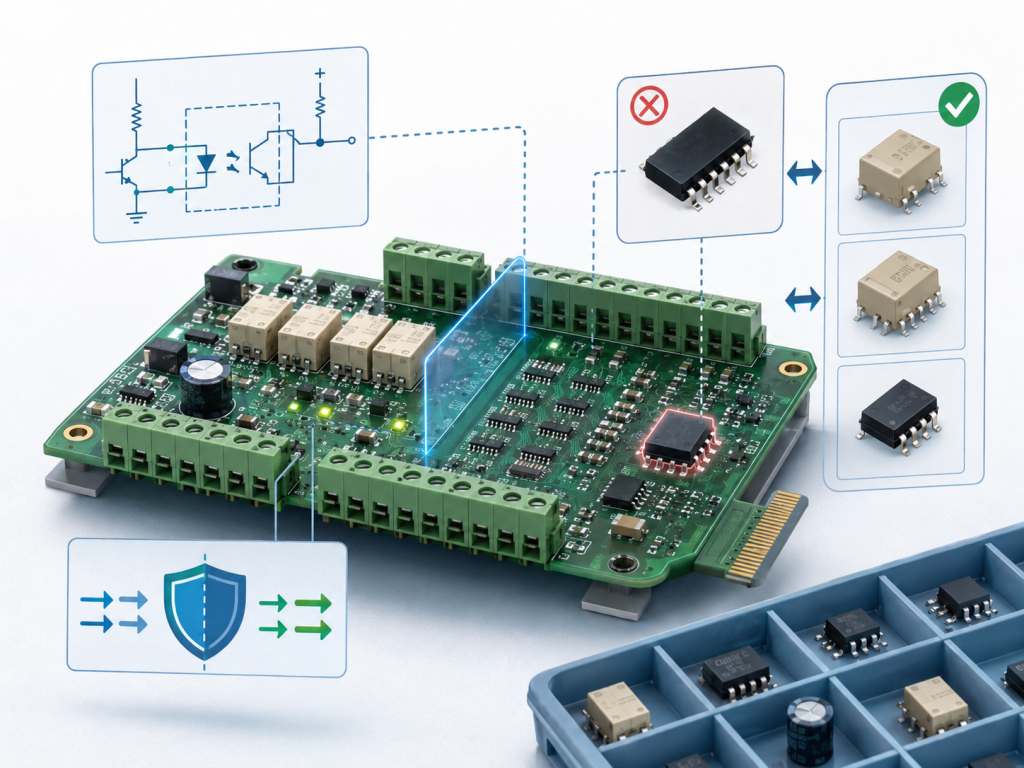
Why Do Industrial Control Customers Need Component Alternative Solutions?
Industrial control products usually have longer lifecycles than consumer electronics, such as PLC controller, industrial drive, power module, communication gateway. However, many electronic components inside these products have shorter market lifecycles. This makes a big challenge for industrial control customers.
A wrong replacement can create more problems than a shortage itself. For many industrial customers, the key questions are:
- Can this replacement fit the original PCB?
- Will it affect the control board’s performance?
- Is the new component available for long-term supply?
- Can the source be traced?
- Can the part be tested before production?
- Can the replacement help reduce future BOM risk?
These are the questions our team focuses on when supporting industrial control projects.
What Problems Do We Solve for Industrial Control Electronics?
Industrial control customers often come to us with urgent sourcing needs, but the deeper problem is usually BOM risk. A single unavailable component may expose several hidden issues in the supply chain, such as single-source dependency, weak AVL management, outdated component selection, or lack of lifecycle monitoring.
For industrial control electronics, we commonly support replacement and sourcing needs for:
- Optocouplers
- MOSFETs and IGBTs
- Gate drivers
- DC-DC converters
- Power management ICs
- Relays
- Connectors
- MCUs
- Ethernet PHYs
- RS485 / RS232 transceivers
- CAN transceivers
- TVS diodes
- Electrolytic capacitors
- Current sensors
- Amplifiers and ADCs
- Crystal oscillators
- Isolation components
In many projects, customers do not only need one alternative part. They need a more complete BOM risk review. We help them to check which parts may affect delivery, which items require immediate sourcing attention, and which components should have approved alternatives before mass production.
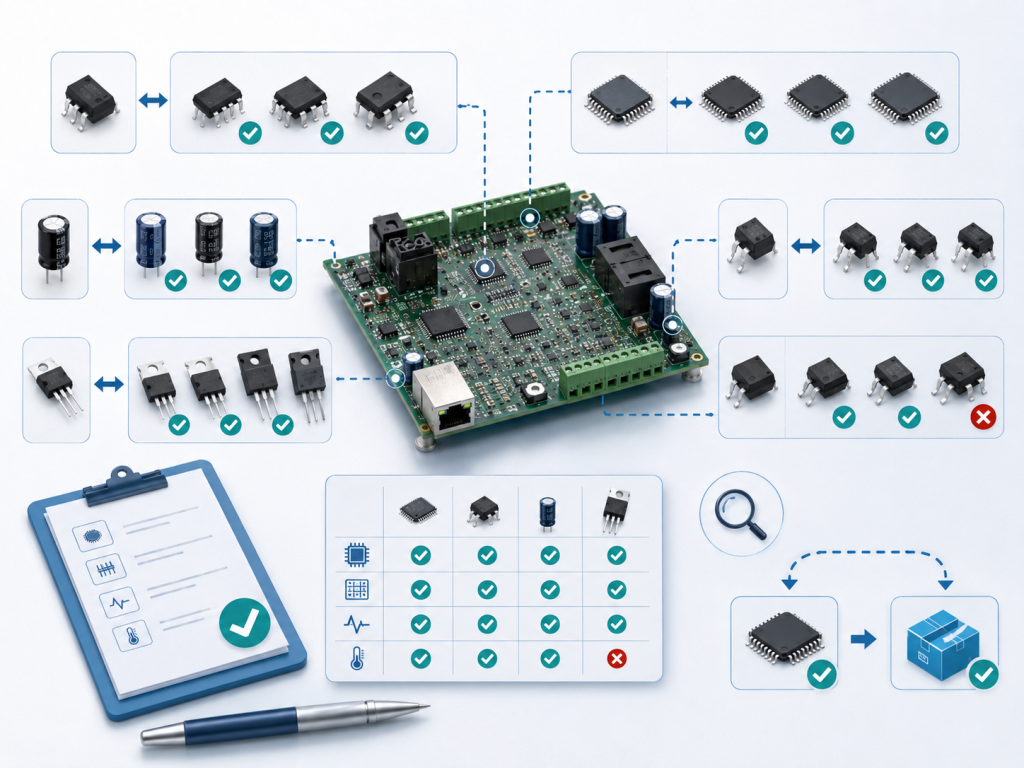
How Our Industrial Control Component Alternative Process Works?
For industrial control applications, we usually support customers through five practical steps.
1. BOM Risk Review
The process starts with the customer’s BOM. Our team checks whether the listed components have lifecycle, lead time, sourcing, or availability risks.
For industrial control projects, we pay close attention to:
- EOL or obsolete parts
- NRND components
- Long lead-time items
- Single-source components
- Parts with unstable pricing
- Special package components
- Industrial temperature grade requirements
- Parts from uncertain supply channels
- Components with limited future availability
This step helps customers understand which components may become production risks before they create delivery problems.
2. Alternative Part Shortlist
After identifying risky components, we start building an alternative shortlist. We compare important details such as:
- Electrical parameters
- Package type
- Pin compatibility
- Operating voltage
- Current rating
- Power dissipation
- Switching speed
- Tolerance
- Isolation voltage
- Temperature range
- Lifecycle status
- Brand availability
- MOQ and lead time
- Datasheet differences
For some components, a drop-in replacement may be possible. For others, the customer may need engineering approval, firmware adjustment, circuit review, or PCBA validation.
Our role is to give customers clear options instead of one risky recommendation.
3. Engineering Review
Industrial control products often work in demanding environments. A replacement component should be reviewed based on the real application, not only the part number.
For example, a MOSFET alternative for a motor drive board should be checked for voltage rating, current capacity, Rds(on), gate charge, thermal resistance, package, and switching behavior. A communication IC alternative should be checked for protocol compatibility, ESD protection, operating temperature, and long-term availability.
During the engineering review stage, we help customers compare specifications and highlight differences that may affect:
- Power stability
- Signal quality
- Communication reliability
- Thermal performance
- EMC behavior
- Control accuracy
- System response
- Production test results
4. Sample and Test Support
For industrial control customers, sample testing is often necessary. Even when a replacement looks suitable in the datasheet, the customer still needs to verify it in the actual circuit.
Depending on the project requirements, Melson can support:
- Sample sourcing
- Visual inspection
- X-Ray inspection
- De-Cap verification
- Functional testing
- Batch record checking
- PCBA trial support
- Shipment video record
5. Traceable Delivery
Traceability matters in industrial control because these products often serve factories, power systems, automation lines, instruments, and long-life equipment.
Melson keeps sourcing and delivery records from RFQ to shipment. Our traceability support may include supplier source records, lot information, inspection results, packing details, shipment photos, and related documentation.
How We Support Industrial Control Customers?
Case 1: Replacing an EOL Optocoupler for an Industrial I/O Module
Customer Situation
An industrial automation customer used an optocoupler in an I/O module for signal isolation. The original part became difficult to source, and the customer needed a safer alternative without changing the existing PCB layout.
Our Support
We reviewed the original optocoupler specifications and compared several possible alternatives. The key comparison points included package type, pinout, current transfer ratio, isolation voltage, propagation delay, input current, operating temperature, and approval information.
Instead of providing only one substitute, we prepared a shortlist of suitable options from different supply channels. This helped the customer compare availability, pricing, and long-term supply potential.
Case 2: Finding a MOSFET Alternative for a Motor Drive Control Board
Customer Situation
A motor drive control board used a MOSFET that became expensive and difficult to purchase in stable quantity. The customer needed an alternative that could support batch production without affecting thermal performance.
Our Support
We compared the original MOSFET with several replacement options based on voltage rating, current rating, Rds(on), gate charge, package, thermal resistance, switching behavior, and brand supply stability.
For motor drive applications, we paid special attention to heat generation and switching loss. A part with similar voltage and current ratings may still perform differently under load. Therefore, we helped the customer avoid choosing a replacement based only on headline specifications.
Case 3: Supporting a Power Supply BOM Alternative for Industrial Equipment
Customer Situation
An EMS customer producing industrial equipment faced sourcing pressure on several power supply components, including capacitors, TVS diodes, and DC-DC converter parts. The issue was not limited to one part number. It affected the overall BOM delivery schedule.
Our Support
We reviewed the power supply section of the BOM and separated the risky items into different priority levels. For each component, we checked electrical specifications, package size, rated voltage, ripple current, lifetime hours, temperature grade, brand availability, and lead time.
For capacitors, lifetime and temperature rating were important. For TVS diodes, clamping voltage, working voltage, surge capability, and package were carefully reviewed. For power modules, we checked input range, output voltage, output current, isolation, efficiency, footprint, and stock condition.
Case 4: Sourcing a Hard-to-Find Communication IC for an Industrial Gateway
Customer Situation
An industrial gateway manufacturer needed a communication IC for an ongoing production order. Market supply was limited, and the customer was concerned about mixed sources, uncertain quality, and future availability.
Our Support
We checked available inventory through qualified channels and compared supplier reliability, batch information, packaging condition, and traceability records. Because communication ICs are critical to system performance, we also helped the customer review possible alternative directions for future design planning.
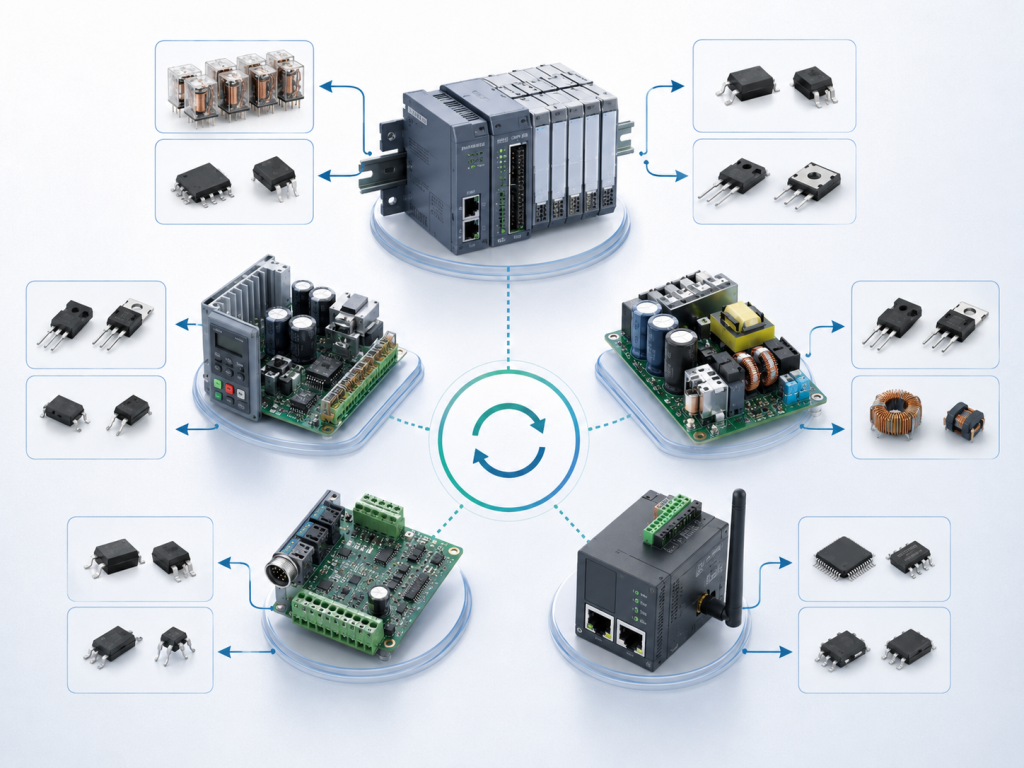
What Components Are Commonly Replaced in Industrial Control Applications?
Industrial control systems include many types of electronic assemblies. Each application has its own component risk points.
| Industrial Control Application | Common Component Alternative Needs |
| PLC and I/O modules | Optocouplers, relays, connectors, MCUs, protection devices |
| Motor drives | MOSFETs, IGBTs, gate drivers, current sensors, capacitors |
| Industrial power supplies | DC-DC converters, rectifiers, TVS diodes, electrolytic capacitors |
| HMI panels | LCD modules, touch controllers, interface ICs, connectors |
| Sensors and instruments | ADCs, amplifiers, references, signal conditioning ICs |
| Industrial communication boards | Ethernet PHYs, RS485 transceivers, CAN transceivers, isolation ICs |
| Robotics control systems | MCUs, power devices, encoders, connectors, motor control ICs |
| Industrial test equipment | Precision resistors, op amps, ADCs, references, protection parts |
How Do We Reduce Risk When Choosing Alternative Components?
Choosing replacement components is not only a purchasing decision. It is a risk management process involving engineering, quality, and supply chain review.
At Melson, we usually evaluate alternative parts from six angles.
1. Parametric Match
We check whether the replacement part meets or exceeds the required electrical parameters. This includes voltage, current, tolerance, timing, resistance, capacitance, isolation, frequency, power rating, and other application-specific values.
2. Package and Pin Compatibility
When the customer wants to avoid PCB redesign, package and pin compatibility become very important. We check footprint, pin arrangement, height, mounting method, and mechanical fit.
For industrial control boards already in mass production, a drop-in replacement can save time and reduce validation workload.
3. Thermal and Reliability Margin
Industrial products may operate for long hours in cabinets, machines, power systems, or factory environments. For power devices, capacitors, converters, and protection parts, thermal margin is a key point.
4. Lifecycle and Supply Stability
A replacement part should not become the next sourcing problem. We review lifecycle status, supplier availability, stock condition, brand stability, and future supply possibility.
5. Testing and Authenticity Verification
When parts come from mixed or non-standard supply channels, inspection becomes more important. Melson supports X-Ray, De-Cap, functional testing, visual inspection, and traceability checking according to project needs.
6. Production Feasibility
A technically suitable part also needs to fit the production plan. We check MOQ, delivery time, batch quantity, price stability, packaging method, and repeat supply ability.
Why Choose Melson for Industrial Control Component Alternative Solutions?
Melson Component Solutions supports customers with practical capabilities built around industrial electronics manufacturing needs.
- We support X-Ray, De-Cap, and functional testing for selected projects.
- From RFQ to shipment, we keep traceability records that support long-term accountability.
- Our supplier network includes authorized distributors, qualified sourcing channels, and long-term partners.
- Available inventory can support urgent sourcing needs, shortage recovery, and production schedule protection.
- We help customers identify EOL parts, long lead-time components, single-source risks, and unstable items before they affect production.
When Should You Start a Component Alternative Review?
The best time to review component alternatives is before production is affected. Many companies start looking for replacements only after a purchasing issue appears. A more practical approach is to include BOM risk review in regular product planning.
Customers should consider a component alternative review when:
- A new industrial control product enters design review
- A product is moving from prototype to mass production
- A PCN or EOL notice is received
- Lead time becomes unstable
- One component depends on a single supplier
- Annual production planning begins
- A customer wants to reduce BOM risk
- A project needs better cost and supply balance
- A production order depends on hard-to-find parts
Early review gives customers more choices. It also allows time for sample testing, approval, documentation, and production planning.
For industrial control products, this is especially useful because the cost of a late component problem is often higher than the cost of early BOM review.
FAQs
1. Can you find drop-in replacement components?
Yes. We first check package, pinout, electrical parameters, temperature grade, lifecycle status, and supply availability. If a drop-in replacement is suitable, we provide it for customer review. If not, we suggest safer alternative options that may require engineering approval.
2. Can you support obsolete or EOL components?
Yes. We support obsolete component sourcing, EOL part search, and alternative component recommendations. For long-term production, we usually suggest customers review both immediate sourcing options and future replacement plans.
3. Do you provide testing before shipment?
Yes. Depending on the project, we can support X-Ray inspection, De-Cap verification, functional testing, visual inspection, and traceability documentation.
4. Can you help with BOM risk analysis?
Yes. We can review customer BOMs for lifecycle risk, long lead time, shortage risk, single-source dependency, and alternative sourcing opportunities.
5. Do you support EMS and PCBA factories?
Yes. We support EMS companies, PCBA manufacturers, OEMs, industrial control equipment companies, and solution providers with component sourcing and alternative support.
6. What information do you need from customers?
We usually need the BOM, original part number, target quantity, application, expected delivery time, required temperature grade, quality requirements, and whether PCB redesign is acceptable.
7. Can you support both urgent sourcing and long-term supply planning?
Yes. For urgent needs, we help search available stock through qualified channels. For long-term needs, we help customers identify alternative parts, review BOM risk, and build more stable sourcing plans.
Work With Melson for Industrial Control Component Alternative Support
Industrial control products need stable components, reliable sourcing, and practical engineering support. Whether you are facing EOL parts, shortage components, long lead time, or BOM risk, Melson Component Solutions can help you find safer alternative options and verify quality before production.
Send us your BOM or shortage list. Our team can help review component risk, search qualified supply channels, compare replacement options, and support your industrial control production with better visibility and traceability.