 English
 中文
中文  english

For UAV manufacturers, component shortage solutions for Drone and UAV projects are not only about finding available stock. They are about protecting engineering schedules, reducing sourcing risk, validating alternatives, and keeping production stable from prototype to mass production.
A Drone or UAV project can move smoothly through design, prototype testing, and pilot production until one critical component suddenly becomes unavailable. It may be an MCU for the flight controller, an IMU sensor for stabilization, a MOSFET for the ESC, or a power management IC for the main board. Once that part is delayed, the whole production plan may slow down.
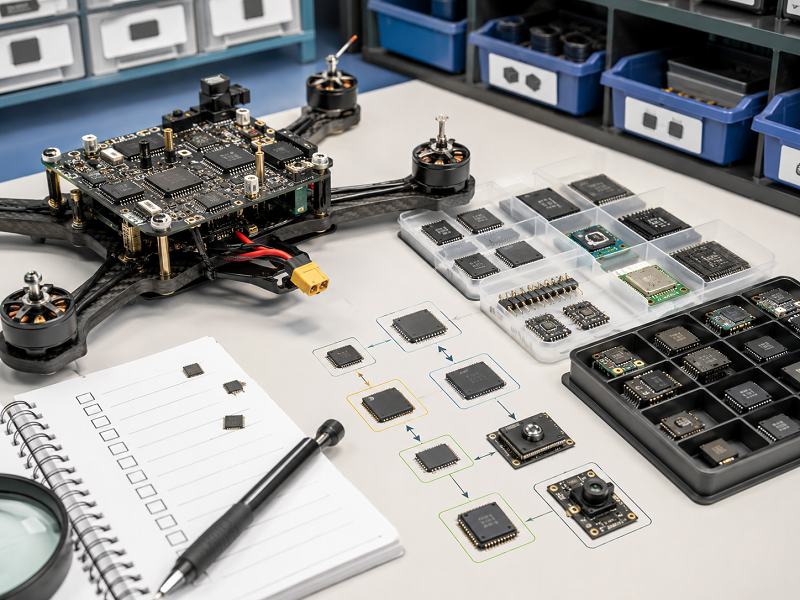
Why Are Component Shortages Critical for Drone and UAV Projects?
Drone and UAV electronics are compact, highly integrated, and performance sensitive. A single missing component can affect several systems at the same time, including:
- Flight controller
- ESC and motor drive system
- GNSS navigation module
- Wireless communication module
- Battery and power management board
- Sensor and stabilization system
For example, if an MCU is out of stock, the firmware may not be easy to move to another model. If an IMU sensor becomes unavailable, the replacement must match the interface, sensitivity, sampling rate, noise level, and calibration behavior. If a MOSFET is changed without checking current rating and thermal performance, the ESC may face reliability problems during high load operation.
This is why UAV shortage handling needs more than purchasing experience. It also requires:
- BOM review
- Lifecycle checking
- Supplier qualification
- Alternative part comparison
- Engineering validation
- Traceability control
Shortage risk is usually more serious in three stages:
- Prototype stage: engineers need fast samples for validation.
- Pilot production stage: the BOM starts to face real purchasing pressure.
- Mass production stage: batch consistency and stable supply become more important.
If shortage risk is not reviewed early, one small component issue can delay the whole project.
What Components Are Most Affected by Shortages in Drone and UAV Electronics?
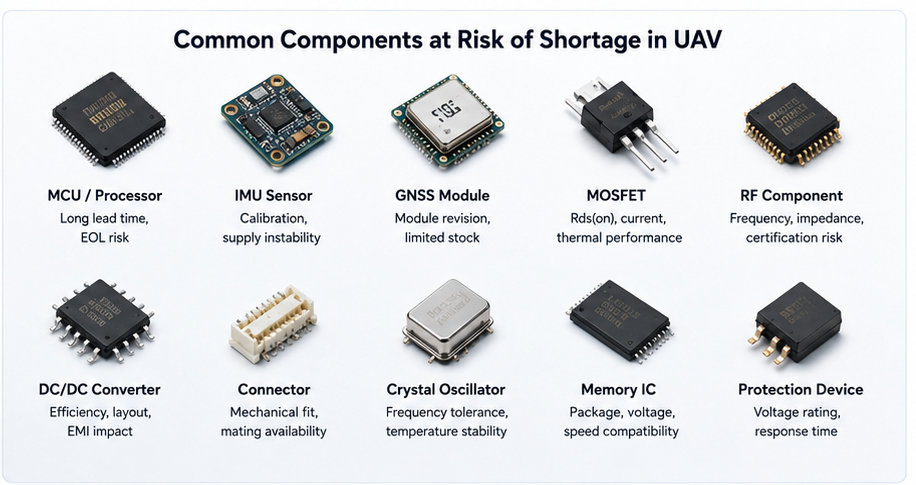
Drone and UAV products use many types of components. Some are easy to replace, while others are tied closely to firmware, PCB layout, RF performance, or flight stability.
| Component Type | Common UAV Application | Main Shortage Risk |
|---|---|---|
| MCU / Processor | Flight controller, control logic | EOL, long lead time, firmware compatibility |
| IMU Sensor | Attitude control, stabilization | Calibration, interface, package risk |
| GNSS Module | Positioning and navigation | Module revision, unstable supply |
| MOSFET | ESC, power switching | Rds(on), current rating, thermal performance |
| DC DC Converter | Power management | Efficiency, layout, EMI impact |
| RF Components | Telemetry, video, remote control | Frequency, impedance, certification concern |
| Connectors | Battery, motor, signal interface | Mechanical fit, mating part availability |
| Crystal Oscillator | MCU clock, RF timing | Frequency tolerance, temperature stability |
| Memory IC | Firmware and data storage | Package, voltage, speed compatibility |
| Protection Devices | ESD, surge, battery protection | Voltage rating, response time |
Among these parts, MCU, IMU, GNSS, RF components, MOSFETs, and power ICs often create the highest risk. They usually need engineering confirmation before replacement.
What Causes Component Shortages in Drone and UAV Supply Chains?
Component shortages usually come from several factors, not just “no stock.”
Common causes include:
- Market demand changes
MCUs, sensors, RF parts, and power devices are widely used in robotics, automotive electronics, industrial control, IoT, and consumer electronics. When demand rises across several industries, lead times become longer. - EOL or NRND status
Some parts remain in old UAV BOMs for years. However, the original manufacturer may later mark them as End of Life or Not Recommended for New Design. If this is not checked early, the issue may appear only when a new production order starts. - Single source design
Some UAV boards rely on one specific brand or one specific part number. If that part becomes unavailable, there may be no ready backup. - Special package or compact layout
UAV boards often use small footprints and high density layouts. Even if a replacement has similar electrical specifications, it may not fit the PCB. - Incomplete BOM information
Descriptions such as “3.3V LDO SOT23” or “IMU sensor I2C” are not enough for accurate matching. The package, voltage, tolerance, temperature grade, and application position must be confirmed.
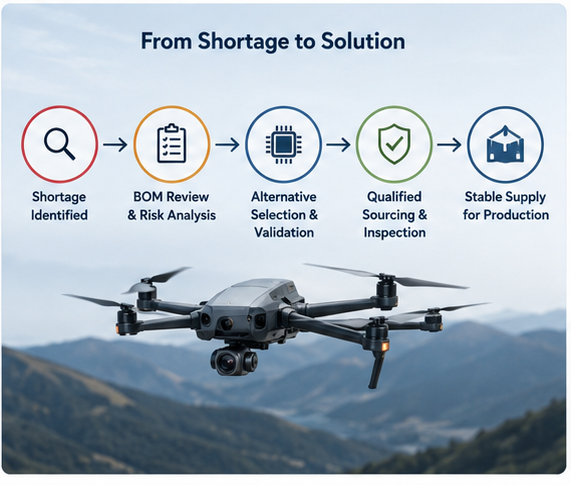
Because of these factors, component shortage solutions for Drone and UAV projects should begin with BOM review instead of emergency purchasing.
How Can BOM Review Reduce Drone and UAV Component Shortage Risk?
A BOM review helps identify shortage risk before it blocks production. For Drone and UAV projects, BOM review should check more than price and stock. It should also check lifecycle, package, technical fit, supplier source, and alternative availability.
| BOM Check Item | Purpose |
|---|---|
| Lifecycle status | Avoid sudden EOL, NRND, or last time buy issues |
| Stock and lead time | Find urgent sourcing risks early |
| Package and footprint | Confirm whether alternatives can fit the PCB |
| Electrical parameters | Reduce mismatch risk |
| Supplier source | Improve authenticity and traceability |
| Alternative availability | Prepare backup options before shortage happens |
| Application position | Know whether the part affects flight, power, RF, or sensors |
A good BOM review can classify components into different risk levels:
- Low risk parts: standard resistors and capacitors with many alternatives.
- Medium risk parts: connectors, crystals, protection devices, and some power components.
- High risk parts: MCU, IMU, GNSS, RF IC, memory, motor driver, and power management IC.
This classification helps the sourcing team focus on the parts that may truly stop production.
What Alternative Components Can Be Used for Drone and UAV Projects?
Alternative component selection is one of the most important parts of shortage management. However, it must be handled carefully. A replacement should not be selected only because the description looks similar.
Drop in alternatives are the easiest to approve. They usually have the same package, pinout, and main electrical parameters. They are often used for:
- Standard resistors
- Capacitors
- Diodes
- TVS devices
- Crystals
- Selected power parts
Functional alternatives have a similar function but may need engineering review. This is common for:
- MCU
- IMU sensor
- DC DC converter
- PMIC
- RF component
- GNSS module
For example, an IMU replacement may use the same I2C or SPI interface, but its register map, sensitivity, noise level, and calibration method may be different.
Brand cross reference alternatives can help when the original brand has long lead time. Still, cross reference does not mean automatic approval. The datasheet must be checked carefully.
Redesign based alternatives may be needed when the original part is obsolete or impossible to source in stable quantity. This can involve PCB layout changes, firmware migration, circuit adjustment, or new testing.
For UAV projects, the most important checks include:
| Check Point | Why It Matters |
|---|---|
| Pinout | Prevents circuit mismatch |
| Package | Ensures PCB footprint compatibility |
| Voltage and current rating | Protects power and control systems |
| Temperature range | Supports outdoor operation |
| Communication interface | Important for sensors and modules |
| Firmware compatibility | Critical for MCU replacement |
| Thermal performance | Important for ESC and power boards |
| Supply stability | Supports pilot run and mass production |
How to Handle MCU, Sensor, and Power Component Shortages in UAV Projects?
MCUs, sensors, and power components need deeper review because they directly affect UAV performance.
For MCU shortages, check:
- Same series alternatives
- Flash and RAM size
- Package and pinout
- ADC channels
- Timers
- UART, SPI, I2C, CAN, or USB interfaces
- Clock requirements
- Operating voltage
- Firmware migration difficulty
Sometimes a higher memory or lower memory version from the same MCU family can work. This can reduce redesign pressure and shorten validation time.
For sensor shortages, check:
- Interface type
- Accuracy
- Measurement range
- Sampling rate
- Power consumption
- Noise level
- Package
- Calibration method
- Driver support
A sensor with similar basic specifications may still behave differently in real flight testing. So, engineering validation is necessary.
For power component shortages, check:
- Voltage rating
- Current rating
- Rds(on)
- Gate charge
- Thermal resistance
- Switching behavior
- Efficiency
- Layout requirements
- EMI impact
A small difference in power performance can affect heat, battery life, EMI, or motor drive stability. Therefore, power alternatives should be checked by both sourcing and engineering teams.
How Can Qualified Supplier Networks Improve Availability?
During component shortages, supplier selection becomes very important. A low price from an unknown source may look attractive, but it can bring quality and traceability risk.
A qualified supplier network can support:
- Faster stock checking
- Better lead time comparison
- Access to reliable channels
- Stable batch supply
- Lower counterfeit risk
- Better date code control
- Clearer traceability records
- More practical backup options
For UAV projects moving from prototype to mass production, it is helpful to build an AVL. This allows the customer to approve more than one supplier, brand, or component option before shortage happens. When the primary part becomes unstable, the backup option can be used faster.
How Do We Control Counterfeit Risk During Component Shortages?
Counterfeit risk often increases during shortage periods. When official stock is limited and prices change quickly, unknown sources may appear with parts that are difficult to verify.
For Drone and UAV electronics, this risk must be handled carefully because component quality can affect flight stability, power safety, and communication reliability.
| Inspection Method | Purpose |
|---|---|
| Visual inspection | Check marking, package, label, and surface condition |
| X Ray inspection | Check internal structure and bonding consistency |
| De Cap inspection | Verify die structure for high risk ICs |
| Functional testing | Confirm basic electrical performance |
| Traceability review | Reduce unknown source risk |
| Packaging review | Check label, reel, bag, and date code |
Critical parts such as MCU, IMU, GNSS module, RF IC, memory IC, and power IC should receive closer inspection when sourced from shortage markets. A complete record from RFQ to shipment also helps customers trace the component source later.
Case Study: Solving a Drone Component Shortage Before Pilot Production
Customer Background
A Drone manufacturer was preparing for pilot production of a compact UAV control system. The project included:
- 1 flight control board
- 1 ESC board
- 1 GNSS module
- 1 wireless communication module
- About 320 line items in the BOM
- Planned pilot run quantity: 500 sets
The prototype had passed basic functional testing, and the customer planned to move into small batch production within four weeks.
Challenge
During purchasing, two serious problems appeared:
- The MCU on the flight control board had a lead time of 18 to 22 weeks.
- The selected IMU sensor had unstable market availability and large price fluctuation.
- Three MOSFETs used on the ESC board also had limited stock from regular channels.
If no solution was found, the pilot run could be delayed by at least 8 weeks.
Our Solution
Our team reviewed the full BOM and marked high risk components first. We focused on MCU, IMU, GNSS module, MOSFETs, power management ICs, and RF related parts.
For the MCU, we checked same series options first to reduce firmware migration risk. We compared:
- Memory size
- Peripheral interfaces
- Pin compatibility
- Package
- Clock requirements
- Operating voltage
- Available stock
For the IMU sensor, we prepared two candidate alternatives and compared:
- Interface
- Measurement range
- Noise performance
- Sampling rate
- Package
- Driver support
- Supply stability
For the MOSFETs, we compared Rds(on), voltage rating, current rating, gate charge, package, and thermal performance.
At the same time, we checked supplier sources and arranged inspection for high risk parts, including visual inspection, packaging review, traceability review, and X Ray inspection for selected ICs.
Result and Customer Satisfaction
The customer received qualified samples within 10 working days. After internal validation, one MCU option and one IMU option were added to the approved backup list.
The project achieved the following results:
- Pilot production delay was reduced from an estimated 8 weeks to about 2 weeks.
- 6 high risk components were identified before production.
- 3 alternative parts were approved for backup use.
- The customer completed the 500 set pilot run without changing the main PCB layout.
- A backup BOM was prepared for the next production batch.
The customer was satisfied because the solution did not only solve the urgent shortage. It also helped them build a more stable sourcing plan for future UAV production.
How Can Long Term Supply Planning Prevent Future UAV Component Shortages?
Emergency sourcing can solve an urgent shortage, but long term supply planning is more valuable. For Drone and UAV projects, this planning should begin during design or early prototype stage.
A practical plan may include:
- Building an AVL for critical components.
- Preparing second source options.
- Checking EOL, PCN, and ECN information regularly.
- Reviewing long lead time parts before pilot production.
- Keeping safety stock for high risk components.
- Creating a backup BOM for mass production.
- Planning last time buy for EOL components when needed.
The best shortage solutions are not only emergency actions. They combine BOM review, lifecycle monitoring, alternative approval, supplier qualification, inspection, and inventory planning.
Why Choose Us for Drone and UAV Component Shortage Solutions?
For Drone and UAV projects, we do not simply search for one available part. We review the BOM, identify shortage risks, compare possible alternatives, check supply stability, and support traceable sourcing for both prototype and production needs.
Our support can include:
- BOM health analysis
- Shortage component sourcing
- EOL and obsolete component support
- Alternative component recommendation
- Supplier qualification
- Inventory checking
- X Ray inspection
- De Cap inspection
- Functional testing
- Traceability from RFQ to shipment
For customers working on flight controllers, ESC boards, communication modules, GNSS systems, battery management circuits, or power management boards, component sourcing must be accurate and responsive. A wrong replacement may create more work than the shortage itself. That is why our process focuses on both availability and technical suitability.
FAQs About Component Shortage Solutions for Drone and UAV Projects
Q1: What should I do first when a UAV component is out of stock?
Check whether the part is temporarily out of stock, long lead time, EOL, or NRND. Then review the package, parameters, application position, and possible alternatives.
Q2: Can you help if our BOM only has specifications but no exact part number?
Yes. We can review the specification, package, value, voltage, tolerance, application position, and BOM context to recommend possible parts or candidate series.
Q3: Are alternative components safe for drone flight control systems?
Yes, if they are properly reviewed and tested. Package, pinout, interface, accuracy, temperature range, power consumption, firmware compatibility, and supply stability should all be checked.
Q4: Which UAV components need the most careful shortage planning?
MCU, IMU, GNSS module, RF components, MOSFET, power management IC, memory IC, connectors, and key sensors usually need more attention.
Q5: Can you support both prototype and mass production sourcing?
Yes. Prototype sourcing focuses on fast sample availability and validation. Mass production sourcing focuses on stable supply, batch consistency, traceability, and long term delivery.
Call to Action
Need help with Drone or UAV component shortages?
Send us your BOM, target quantity, preferred brands, and delivery requirements. Our team can help review shortage risks, check EOL status, recommend alternative components, and support reliable sourcing from prototype to mass production.