 English
 中文
 english


5CGXBC3B6U19C7N is an Altera Cyclone V GX FPGA in a 19 mm, 484-ball U19 UBGA package with 0.8 mm pitch. It provides 13,460 ALMs, 1,350 Kb of M10K memory, 57 DSP blocks, four PLLs, and three transceiver channels.
This blog covers the 5CGXBC3B6U19C7N specifications, availability, sourcing risks, and alternative options to help with part selection, BOM maintenance, and purchasing decisions.
What Is the 5CGXBC3B6U19C7N?
The 5CGXBC3B6U19C7N combines programmable logic, embedded memory, DSP resources, clock management, GPIO, and serial transceivers in one Cyclone V GX device. For the C3 member, the U19 package exposes 208 GPIOs. Its B6 transceiver option provides three channels with a documented data-rate range of 614 Mbps to 3.125 Gbps.
In this OPN, the first B selects an option with no hard PCIe block and no hard memory controller. A design that depends on either hardened function therefore needs a different device option. For an existing assembly, compatibility is determined by the released Quartus project, U19 pin assignment, PCB footprint, power tree, and configuration method—not by the family name alone.
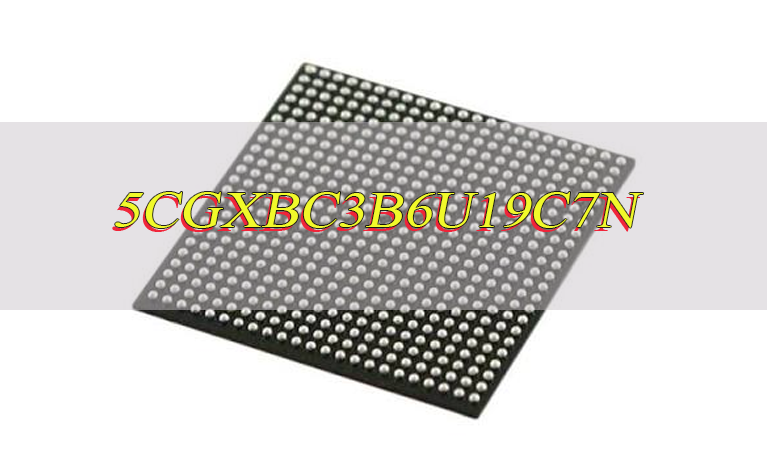
5CGXBC3B6U19C7N Specification Overview
Use the values below to confirm the exact device and package before checking whether it fits a design. Logic elements, ALMs, registers, memory, DSP blocks, and I/O are different resource measures; the fitted Quartus report shows how much of each resource the actual project uses.
| Specification | Value |
|---|---|
| Manufacturer | Altera |
| Family | Cyclone V GX |
| Device member | C3, 36K-logic-element class |
| Process | 28 nm |
| Adaptive logic modules | 13,460 ALMs |
| Registers | 53,840 |
| Embedded memory | 1,350 Kb M10K and 182 Kb MLAB |
| DSP resources | 57 variable-precision DSP blocks; 114 18 × 18 multipliers |
| FPGA PLLs | 4 |
| Transceiver channels | 3 |
| Transceiver data-rate range | 614 Mbps to 3.125 Gbps |
| Package and GPIO | U19, 484-ball UBGA, 19 mm body, 0.8 mm pitch, 208 GPIOs |
| Temperature grade | Commercial, 0°C to 85°C junction temperature |
| Fabric speed grade | 7 |
| Shipping and moisture handling | Tray; MSL 3; 168-hour floor life at no more than 30°C and 60% RH after opening |
What Does the 5CGXBC3B6U19C7N Part Number Mean?
Read the complete OPN as a device configuration, not simply as a Cyclone V family name. Its fields identify the functional option, resource member, transceiver configuration, package, operating grade, and packaging option. Retaining the complete code on the BOM, RFQ, purchase order, and incoming-inspection record makes any proposed change visible before material is accepted.
| Code | Meaning |
|---|---|
| 5C | Cyclone V family |
| GX | GX variant with serial transceivers |
| B | Embedded-hard-IP option; no hard PCIe block and no hard memory controller |
| C3 | C3 resource member in the 36K-logic-element class |
| B | Three-transceiver-channel configuration |
| 6 | Transceiver speed grade with a maximum data-rate class of 3.125 Gbps |
| U19 | 484-ball UBGA, 19 mm body, 0.8 mm pitch |
| C | Commercial temperature grade |
| 7 | FPGA fabric speed grade 7 |
| N | Lead-free packaging option |
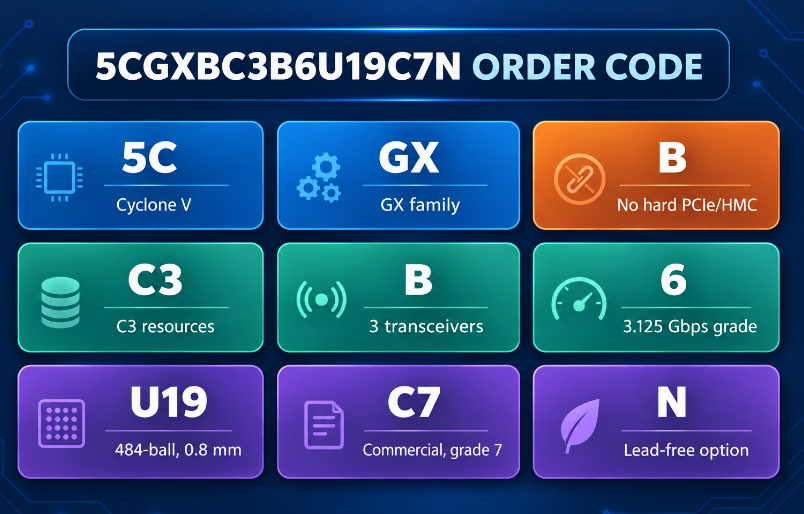
The two B characters have different roles. The first selects the embedded-hard-IP option; the later B belongs to the transceiver configuration. A quotation that shortens the code or substitutes either field should be clarified before the order is accepted.
Where Can You Find the 5CGXBC3B6U19C7N Datasheet, Pinout and Package Information?
Start with the official 5CGXBC3B6U19C7N product page for the exact ordering number, package, shipping format, moisture classification, and current lifecycle entry. The Cyclone V Device Datasheet supplies the electrical, timing, configuration, and operating limits.
For a footprint or replacement decision, the family datasheet is not enough; the U19 pin file and the released Quartus project are also required. If another Cyclone V device is proposed, follow Altera’s pin-migration verification procedure and inspect both devices in Quartus Pin Planner. Keep the document revisions, selected OPN, U19 pin file, compilation report, applicable errata, and manufacturer change notices with the approved BOM so purchasing and engineering work from the same baseline. You can download the datasheet of 5CGXBC3B6U19C7N via the following link:
What Affects 5CGXBC3B6U19C7N Price, MOQ and Lead Time?
Price, minimum order quantity, and delivery time cannot be compared without the requested quantity and supply route. An offer for ready inventory is different from transfer stock or material that still has to be sourced, so the quotation should identify which route supports the stated price and date. Manufacturer lifecycle status is a separate classification; it does not prove that a supplier has allocable stock.
- Unit-price basis: confirm the exact quantity and price break covered by the unit price, the quotation currency, and the validity period.
- MOQ and packing multiple: determine whether the seller accepts the requested quantity or requires a full tray, supplier MOQ, or other packing multiple.
- Quantity status: separate physical, allocable inventory from supplier-confirmed or expected stock; record whether split shipment is acceptable.
- Lead-time basis: identify when the clock starts, whether it covers sourcing or internal transfer, and whether the quoted endpoint is dispatch or delivery.
- Delivery terms: state the ship-to location, freight basis, taxes, payment terms, and target arrival date so competing offers describe the same requirement.
A current quote needs the exact OPN, required quantity, destination, required delivery date, and whether split shipments are acceptable. If alternatives may be considered, make clear that a different ordering code still requires engineering approval.
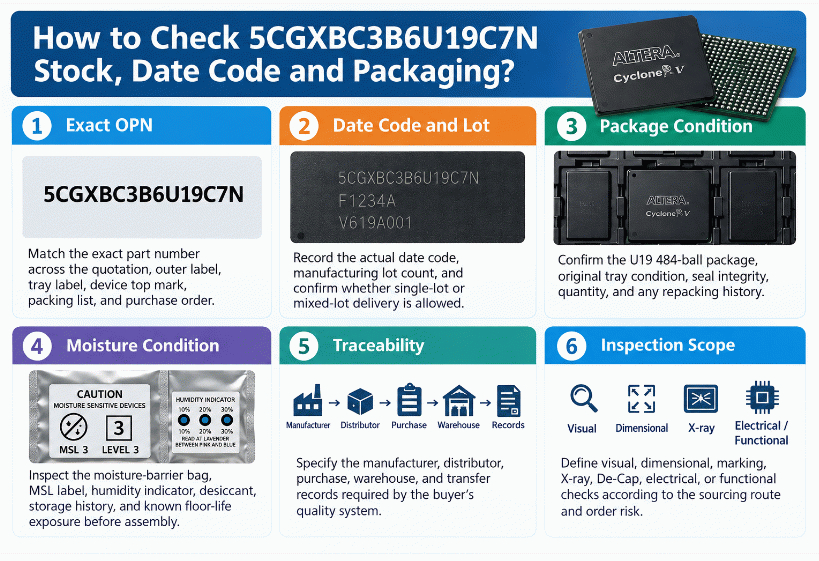
How Can You Check 5CGXBC3B6U19C7N Stock, Date Code and Packaging?
Treat stock as verified only when the quotation, physical devices, labels, packaging, and supporting records all refer to the same offered lot. A quantity shown on a website or distributor line card does not establish that link by itself. Put any date-code limit, single-lot requirement, or repacking restriction in the RFQ before the supplier reserves material.
- Exact OPN: match 5CGXBC3B6U19C7N across the quotation, outer label, tray label, device top mark, packing list, and purchase order.
- Date code and lot structure: record the actual date code, manufacturing lot count, and whether single-lot or mixed-lot delivery is allowed.
- Package condition: confirm the U19 484-ball package, original tray condition, seal integrity, quantity, and any repacking history.
- Moisture condition: inspect the moisture-barrier bag, MSL label, humidity indicator, desiccant, storage history, and known floor-life exposure before assembly.
- Traceability: specify the manufacturer, distributor, purchase, warehouse, and transfer records required by the buyer’s quality system.
- Inspection scope: define visual, dimensional, marking, X-ray, De-Cap, electrical, or functional checks according to the sourcing route and order risk.
- Release criteria: agree how missing records, repacking, mixed date codes, quantity changes, or inspection exceptions will be accepted or rejected before dispatch.
An older date code is not automatically unusable, and a recent date code is not proof of acceptable condition. Storage, moisture protection, solderability where relevant, traceability, and the agreed inspection results determine whether the offered lot meets the order requirements.
Can 5CGXFC3B6U19C7N Replace 5CGXBC3B6U19C7N?
Do not approve 5CGXFC3B6U19C7N as a drop-in replacement from the part numbers alone. The relevant change is the embedded-hard-IP field: the B option in 5CGXBC3B6U19C7N has no hardened PCIe block or hardened memory controller, while the Cyclone V C3 maximum-resource table lists the F option with up to 1 hard PCIe block and 1 hard memory controller. That difference may affect dedicated pins and the compiled implementation even though the member, transceiver code, package, and grade appear similar.
| Ordering Field | 5CGXBC3B6U19C7N | 5CGXFC3B6U19C7N |
|---|---|---|
| Embedded hard IP | B option: no hard PCIe block and no hard memory controller | F option: C3 table lists up to 1 hard PCIe block and 1 hard memory controller |
| Device member | C3 | C3 |
| Transceiver configuration | B6 | B6 |
| Package | U19 | U19 |
| Temperature and fabric grade | C7 | C7 |
| Packaging suffix | N | N |
Qualification has to use the released design, with the ordering-code comparison serving only as the starting point:
- Decode the changed field: document the B-to-F hard-IP change and any function, dedicated-pin, or configuration consequence for the actual design.
- Compare the package: check body, pitch, ball map, power, configuration, clock, transceiver, reserved, and no-connect positions.
- Inspect pin migration: use Quartus Pin Planner to resolve bank-voltage, VREF, clock, dedicated-function, and transceiver differences.
- Recompile the design: retarget the released project and review fitter messages, resource use, IP settings, pin assignments, and the complete timing report. A failed compile rejects the candidate at this stage; a successful compile moves it to board and hardware verification rather than approving it outright.
- Recheck the board: verify power sequencing, decoupling, thermal margin, configuration circuitry, reference clocks, and high-speed-channel limits.
- Validate hardware: build a controlled first article and run the product’s startup, interface, power, thermal, functional, and regression tests.
For the released design, keep 5CGXBC3B6U19C7N in the production BOM until these checks pass and the change is approved. Sourcing can identify the F-device candidate and collect its documentation, but the design owner must approve electrical, pin, timing, configuration, and application equivalence.
Why Source 5CGXBC3B6U19C7N Through Melson Components?
Melson’s published services are most relevant when this FPGA is already on an approved BOM but the usual supply route cannot meet demand, a new source needs inspection, or an alternative is being considered. State the required service in the RFQ so the quotation defines the sourcing, inspection, documentation, and approval scope for the offered material.
- Free BOM Health Check: Melson can review a BOM for EOL, last-time-buy, extended lead-time, and availability risks, helping purchasing teams identify vulnerable lines before they interrupt production.
- X-Ray Verified Inspection: Melson publishes support for X-ray, visual inspection, De-Cap, and functional testing when required. Buyers can define which checks apply to the offered lot and receive the corresponding inspection scope rather than assuming every test is included.
- 15-Year Traceability Records: Melson states that RFQ, sourcing, inspection, packing, and shipment records are retained for up to 15 years, giving long-life and regulated programs a clearer audit trail for the supplied material.
- EOL & Alternative Support: when an exact part becomes obsolete, constrained, or subject to an unacceptable lead time, Melson can search for supply and propose alternatives for engineering review. A proposed substitute is not released until the customer’s qualification requirements are met.
For a quote, send the exact part number, required quantity, target delivery date, and destination, plus the accepted date-code range, lot and packaging restrictions, traceability documents, and required inspection. Include the BOM or shortage list when several components need review, and state whether alternative parts may be proposed. Send the request to sales@melsonchip.com.
FAQs About 5CGXBC3B6U19C7N
Q1: Is the 5CGXBC3B6U19C7N discontinued?
A1: Altera listed the exact device as In Production when checked on September 8, 2026. Lifecycle status can change, so confirm the current manufacturer entry when a new order is placed. Stock and delivery terms are assessed separately in the supplier’s current quotation.
Q2: Why do some listings show different logic counts for 5CGXBC3B6U19C7N?
A2: Logic elements, ALMs, and registers are different resource measures and should not be compared as if they were the same count. For design fit, use the official C3 resource table and the fitted Quartus report for the actual project.
Q3: Does the N suffix prove that the supplied lot is RoHS compliant?
A3: No, N identifies the lead-free packaging option, while compliance should be supported by current manufacturer or lot documentation. Keep the ordering-code meaning and the required regulatory declaration as separate checks.
Q4: Does a different production lot require a new FPGA bitstream?
A4: Not merely because the date code or lot number changed. Confirm the exact OPN and review applicable manufacturer change notices, errata, silicon revisions, and the product’s qualification rules; bitstream changes are driven by the implemented design and device compatibility, not the lot label alone.
Q5: Does MSL 3 mean every stored device must be baked before assembly?
A5: No, the handling decision depends on the sealed condition and documented exposure history. Check the moisture-barrier bag, humidity indicator, storage, remaining floor life, and the assembly site’s qualified handling procedure before deciding whether baking is required.
Q6: Is the device top marking enough to confirm authenticity?
A6: No, a top mark is one identity check, not proof of source, condition, or authenticity. Review labels, dimensions, package condition, traceability, lot consistency, and risk-appropriate inspection or testing together.
Q7: Should an older date code be rejected automatically?
A7: No, date code alone does not establish usability or condition. Evaluate storage history, moisture protection, package condition, traceability, solderability where required, and the buyer’s approved acceptance criteria.