 English
 中文
中文  english

Introduction
In LED lighting projects, one unavailable component can delay the full production schedule. It may be an LED driver IC, a MOSFET, a bridge rectifier, an electrolytic capacitor, or even a connector used in the power input section. For lighting manufacturers, finding LED lighting component alternatives is not only a purchasing task. It is a technical decision that affects brightness, efficiency, heat, lifetime, safety, and long term production stability.
A replacement part may look similar on paper, but LED lighting circuits are sensitive to current control, thermal behavior, ripple, surge protection, dimming compatibility, and certification requirements. That is why a reliable component alternative solution should start with BOM review, parameter comparison, package confirmation, supplier checking, and sample validation.
For LED lighting companies, the right alternative strategy can help reduce shortage risk, control cost, avoid End of Life issues, and keep production moving from prototype to mass production.
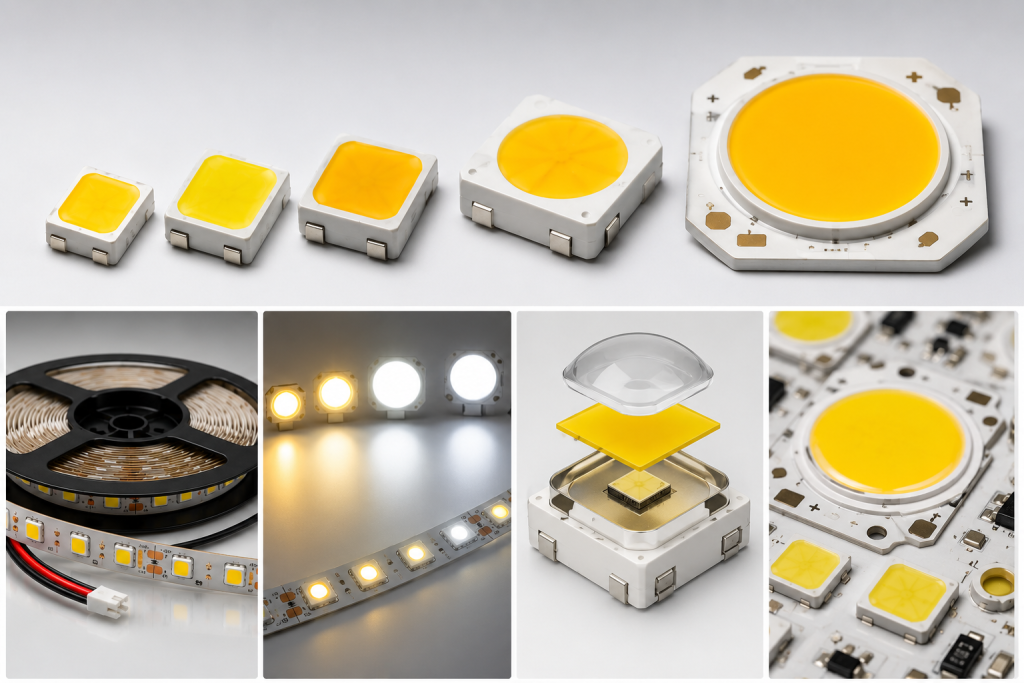
Why Do LED Lighting Projects Need Component Alternatives?
LED lighting products often have long market lifecycles. A street light, high bay light, panel light, explosion proof light, or industrial LED fixture may stay in production for several years. During this time, the original BOM may face many changes.
Common reasons for component alternatives include:
- The original component is out of stock.
- The lead time becomes too long.
- The manufacturer announces EOL or NRND status.
- The price increases sharply.
- The current supplier cannot support stable batches.
- The customer needs a cost effective second source.
- The production volume increases and requires better supply planning.
- The old component no longer fits updated compliance needs.
For LED lighting projects, replacement decisions must be made carefully. A wrong alternative may affect output current, LED brightness, dimming performance, EMI behavior, temperature rise, or product lifetime.
In other words, LED lighting component alternatives are not only used when a shortage happens. They are also useful for lifecycle control, cost optimization, and long term supply stability.
What Components Commonly Need Alternatives in LED Lighting?
LED lighting products include driver boards, LED modules, power input circuits, dimming circuits, protection circuits, and connectors. Many components in these circuits may need alternatives when shortage, EOL, or price pressure appears.
| Component Type | Common Use in LED Lighting | Alternative Risk |
|---|---|---|
| LED Driver IC | Constant current driver, dimming control | Current accuracy, dimming compatibility, EMI |
| MOSFET | Switching circuit, power control | Rds(on), voltage, current, thermal performance |
| Electrolytic Capacitor | Input and output filtering | Lifetime, ripple current, temperature rating |
| MLCC | Filtering and decoupling | Capacitance loss, voltage derating, package |
| Bridge Rectifier | AC input rectification | Voltage, current, thermal capability |
| Optocoupler | Isolation feedback | CTR range, safety approval, package |
| Resistor | Current sensing, voltage divider | Tolerance, power rating, temperature coefficient |
| Inductor / Transformer | Power conversion | Saturation current, core loss, size |
| Connector | Power input and output interface | Pitch, current rating, mechanical fit |
| TVS / Fuse / NTC | Surge, ESD, and inrush protection | Rating, response, surge capability |
| LED Chip / LED Package | Light source | CCT, lumen, Vf, color consistency |
Among these parts, LED driver ICs, MOSFETs, capacitors, optocouplers, connectors, and protection devices often need the most careful review. They directly affect electrical performance, thermal reliability, safety, and production yield.
What Problems Can Poor Component Replacement Cause in LED Lighting?
A poor replacement may seem acceptable during purchasing, but it can create problems during assembly, testing, or field use. LED lighting products are especially sensitive because power, heat, current, and optical performance are closely connected.
Poor component replacement may cause:
- Unstable output current
- Brightness difference between batches
- LED flicker
- Higher temperature rise
- Shorter capacitor lifetime
- EMI test failure
- Dimming incompatibility
- PCB footprint mismatch
- Poor surge protection
- Lower power efficiency
- Connector overheating
- Safety approval risk
- Shorter product lifetime
For example, replacing an electrolytic capacitor only by capacitance and voltage rating is not enough. Ripple current, lifetime hours, ESR, temperature grade, and body size must also be checked. In the same way, replacing a MOSFET only by voltage and current rating may miss Rds(on), gate charge, thermal resistance, and switching loss.
This is why LED lighting component replacement should be handled as an engineering and sourcing process, not a simple part number search.
How Should LED Lighting Component Alternatives Be Evaluated?
A reliable alternative should be checked from several angles. The goal is not only to find a part that is available today, but also to make sure it can support stable production later.
Electrical Parameter Check
The first step is to compare basic and application related parameters, such as:
- Voltage rating
- Current rating
- Power rating
- Tolerance
- Frequency
- Efficiency
- Surge capability
- Leakage current
- Ripple current
- Protection functions
For LED driver boards, current accuracy and protection behavior are especially important. Small parameter changes may affect brightness, flicker, and circuit stability.
Package and Footprint Check
Even if the electrical parameters are close, the part must fit the PCB. The review should include:
- SMD or through hole type
- Pin pitch
- Body size
- Pinout
- Thermal pad
- Polarity
- Height limit
- PCB footprint compatibility
For compact lighting drivers, height and thermal pad design can be just as important as electrical rating.
Thermal Performance Check
LED lighting products often work in enclosed or semi enclosed structures. Heat has a direct impact on lifetime. Therefore, replacement parts should be checked for:
- Junction temperature
- Thermal resistance
- Power dissipation
- Heat path
- Ambient temperature
- Derating margin
- Fixture enclosure temperature
This is especially important for MOSFETs, bridge rectifiers, driver ICs, inductors, and capacitors.
Lifetime and Reliability Check
For lighting applications, long term reliability matters. Customers often expect stable performance over years of use. The review should include:
- Capacitor lifetime hours
- Operating temperature
- LED lumen maintenance
- Brand reliability
- Batch consistency
- Long term availability
- Field application record
Certification and Compliance Check
Some components affect safety and market compliance. For optocouplers, fuses, connectors, power parts, and protection devices, certification or compliance may be required.
Common checks include:
- UL
- CE related requirements
- RoHS
- REACH
- Safety approval for isolation and protection parts
- Customer specific compliance rules
How to Replace LED Driver ICs in Lighting Projects?
The LED driver IC is one of the most critical parts in a lighting product. It controls output current, dimming function, protection behavior, and power efficiency. Therefore, LED driver IC replacement usually needs circuit review and sample validation.
Before replacing an LED driver IC, the following points should be checked:
- Input voltage range
- Output current accuracy
- Dimming mode
- PWM, analog, TRIAC, 0 to 10V, or DALI compatibility
- Switching frequency
- Efficiency
- Protection functions
- Pinout
- Package
- Peripheral circuit requirements
- EMI behavior
- Thermal performance
- Lifecycle status
- Stock and lead time
If the original IC supports dimming, the alternative must be checked carefully. A driver IC with similar current output may still behave differently under dimming conditions. It may also require changes in peripheral resistors, inductors, compensation circuits, or layout.
In many cases, the best first option is to look for a same series or same family replacement. This can reduce redesign work. If that is not possible, a functional alternative may be selected, but it should go through electrical testing, thermal testing, dimming verification, and EMI review.
How to Choose Alternatives for MOSFETs, Capacitors, and Protection Devices?
Besides LED driver ICs, MOSFETs, capacitors, and protection devices are also common replacement targets in LED lighting projects.
MOSFET Alternatives
When replacing a MOSFET, do not only compare voltage and current. The following items should be reviewed:
- Vds
- Id
- Rds(on)
- Gate charge
- Vgs threshold
- Package
- Thermal resistance
- Switching loss
- Availability
- Brand stability
A MOSFET with higher Rds(on) may create more heat. A part with different gate charge may affect switching behavior and efficiency. For LED driver boards, these details can affect temperature rise and product reliability.
Capacitor Alternatives
Capacitors are widely used in LED power supplies. Replacing them requires careful review, especially for electrolytic capacitors.
Important checks include:
- Capacitance
- Voltage rating
- ESR
- Ripple current
- Lifetime hours
- Temperature rating
- Size and height
- Lead spacing
- Brand and series
- Application position
For LED lighting, capacitor lifetime is closely related to temperature. A low cost alternative may reduce product life if ripple current or temperature rating is not suitable.
Protection Device Alternatives
Protection components help the product handle surge, ESD, overcurrent, and inrush current. Common parts include fuses, TVS diodes, NTC thermistors, MOVs, and surge protection devices.
Replacement checks should include:
- Fuse rating
- TVS breakdown voltage
- Clamping voltage
- NTC resistance
- Surge current rating
- Response time
- Safety approval
- Package and footprint
A good protection alternative should support safety and reliability without affecting normal circuit operation.
How Can BOM Review Help Find Better Alternatives for LED Lighting?
BOM review is one of the most effective ways to find better LED lighting component alternatives before a shortage becomes urgent. It helps the sourcing team and engineering team understand which parts are easy to replace and which parts need deeper validation.
| BOM Review Item | Purpose |
|---|---|
| Lifecycle Status | Avoid EOL and last time buy issues |
| Stock and Lead Time | Identify urgent supply risks |
| Electrical Parameters | Confirm technical suitability |
| Package and Footprint | Avoid PCB mismatch |
| Thermal Rating | Support LED lifetime and safety |
| Certification | Maintain market compliance |
| Alternative Availability | Build backup options for production |
| Cost Structure | Find possible cost saving opportunities |
A professional BOM review can classify parts into different groups:
- Direct replacement parts: easy to replace after parameter and package confirmation.
- Engineering review parts: require datasheet comparison and sample testing.
- High risk parts: may affect safety, dimming, EMI, thermal behavior, or certification.
- Redesign related parts: may require PCB or circuit changes.
This approach saves time because the team can focus on the components that truly affect production risk.
Case Study: Solving an LED Driver Component Shortage
Customer Background
A LED industrial lighting manufacturer was preparing for mass production of a high bay light series. The product used an isolated LED driver board and was designed for warehouse and workshop lighting.
The project included:
- 1 LED driver board
- 1 LED light source module
- Around 210 BOM line items
- Planned production quantity: 3,000 units
- Target delivery window: 5 weeks
Challenge
During purchasing, the original LED driver IC became difficult to source. The regular lead time increased to 16 to 20 weeks. At the same time, one electrolytic capacitor series had unstable supply, and the MOSFET used in the switching stage had limited stock.
The customer wanted to avoid a major PCB redesign because the product had already passed internal electrical and thermal testing.
Our Solution
Our team reviewed the full BOM and marked the high risk components first. The focus was placed on:
- LED driver IC
- MOSFET
- Electrolytic capacitor
- Bridge rectifier
- Optocoupler
- Protection devices
For the LED driver IC, we compared two candidate alternatives. The comparison included:
- Input voltage range
- Output current control
- Dimming compatibility
- Protection functions
- Pinout
- Package
- Peripheral circuit differences
- Stock and lead time
For the MOSFET, we compared Rds(on), gate charge, voltage rating, current rating, package, and thermal resistance.
For the electrolytic capacitor, we checked capacitance, voltage, ripple current, lifetime hours, operating temperature, size, and lead spacing.
We also reviewed supplier sources and arranged sample delivery for customer validation.
Result and Customer Feedback
The customer received sample parts within 12 working days. After internal testing, one LED driver IC alternative, one MOSFET alternative, and one capacitor alternative were approved for backup use.
The project achieved the following results:
- The estimated production delay was reduced from 8 weeks to about 2 weeks.
- 5 high risk components were identified before mass production.
- 3 alternative parts were approved for the backup BOM.
- The 3,000 unit production plan continued without major PCB redesign.
- The customer built a second source plan for the next production batch.
The customer was satisfied because the solution did not only solve the urgent shortage. It also improved the long term supply plan for the lighting product series.
How Do We Support LED Lighting Component Alternative Solutions?
For LED lighting projects, we do not simply search for a similar part number. We review the BOM, check technical suitability, compare available alternatives, verify supplier sources, and support stable sourcing from prototype to production.
Our support can include:
- BOM review
- MPN confirmation
- Alternative part recommendation
- EOL and obsolete component sourcing
- LED driver IC sourcing
- MOSFET and capacitor replacement support
- Qualified supplier network support
- Authenticity inspection
- X Ray, De Cap, and functional testing when needed
- Traceability from RFQ to shipment
- Prototype and mass production sourcing support
For LED lighting manufacturers, reliable component alternatives can reduce shortage risk, support stable production, and improve supply chain flexibility. This is especially valuable for products such as street lights, high bay lights, panel lights, industrial lighting, outdoor lighting, and explosion proof LED lights.
FAQs About LED Lighting Component Alternatives
Q1: Can LED driver ICs be replaced without changing the PCB?
Sometimes yes, but it depends on the pinout, package, peripheral circuit, dimming mode, and protection functions. Even if the package looks the same, sample validation is still recommended.
Q2: What should be checked before replacing a MOSFET in an LED driver board?
Vds, Id, Rds(on), gate charge, Vgs threshold, package, thermal resistance, switching loss, and supply stability should be checked.
Q3: Can capacitors from different brands be used as alternatives?
Yes, but the replacement should match capacitance, voltage rating, ESR, ripple current, lifetime hours, temperature rating, size, and lead spacing.
Q4: How do you reduce risk when choosing component alternatives for LED lighting?
Risk can be reduced through BOM review, datasheet comparison, package confirmation, sample testing, supplier screening, and traceability control.
Q5: Can you help with EOL components in old LED lighting projects?
Yes. We can help check remaining stock, review last time buy options, recommend possible alternatives, and evaluate whether PCB changes are needed.
Q6: Are LED component alternatives suitable for mass production?
Yes, if they are properly validated and the supply source is stable. For mass production, batch consistency, lead time, supplier reliability, and long term availability should all be confirmed.
Conclusion
LED lighting component alternatives are important for shortage control, EOL replacement, cost management, and production continuity. However, a good alternative solution should not rely only on price or stock. It should combine electrical review, package checking, thermal evaluation, reliability comparison, supplier qualification, and sample validation.
For LED lighting manufacturers, preparing reliable backup parts early can reduce production delays and improve supply chain stability. Whether the project involves LED driver boards, power supplies, MOSFETs, capacitors, connectors, protection devices, or LED packages, a structured alternative strategy can help keep production on schedule.
Call to Action
Need help with LED lighting component alternatives?
Send us your LED lighting BOM, target quantity, preferred brands, and delivery requirements. Our team can review shortage risks, check EOL status, recommend reliable component alternatives, and support stable sourcing from prototype to mass production.