 English
 中文
 english


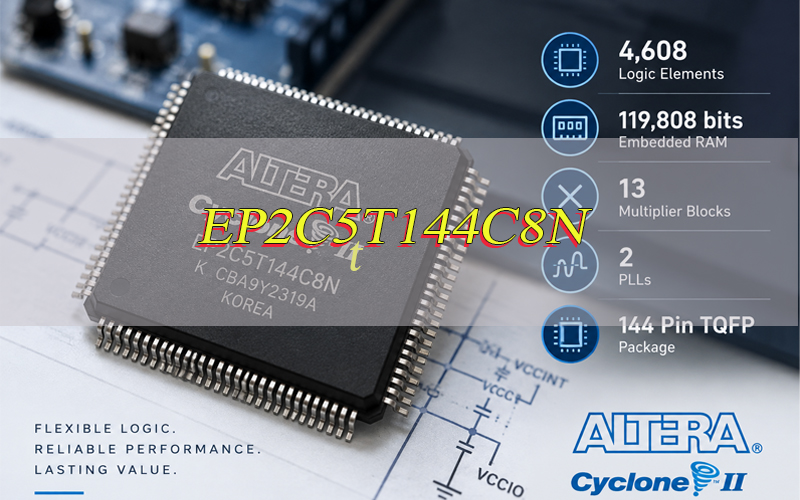
EP2C5T144C8N is an Altera Cyclone II FPGA with 4,608 logic elements, 119,808 embedded RAM bits, 13 embedded multiplier blocks, two PLLs, and a 144 pin TQFP package. It is still found in established industrial control, interface, embedded, and data processing designs.
If this FPGA is already on your BOM, confirm the datasheet specifications, T144 pinout, speed grade, temperature grade, configuration requirements, and sourcing condition before approving a replacement or production lot.
What Is the EP2C5T144C8N?
EP2C5T144C8N belongs to the Cyclone II FPGA family originally developed by Altera. The EP2C5 device provides:
- 4,608 logic elements
- 26 M4K RAM blocks
- 119,808 embedded RAM bits
- 13 embedded 18 × 18 multiplier blocks
- 2 PLLs
These resources allow the FPGA to implement state machines, timing control, interface logic, parallel data handling, memory buffering, and arithmetic functions in one programmable device.
Cyclone II is now a legacy device family from a development software perspective. Altera currently lists Quartus II 13.0sp1 as the latest Quartus release supporting Cyclone II, so access to the original project and a compatible software environment matters when maintaining existing equipment.
What Does the EP2C5T144C8N Part Number Mean?
The complete ordering code identifies the FPGA family, device size, package, temperature grade, speed grade, and lead free option.
| Code | Meaning | What to Confirm |
|---|---|---|
| EP2C | Cyclone II family | Correct FPGA family |
| 5 | EP2C5 device | Correct logic capacity |
| T | TQFP | Correct package type |
| 144 | 144 pins | Correct PCB footprint |
| C | Commercial grade | Correct temperature grade |
| 8 | Speed grade 8 | Correct timing grade |
| N | Lead free device | Correct material version |
For Cyclone II, C means commercial temperature with a junction temperature range of 0°C to 85°C. Speed grades are 6, 7, and 8, with 6 being the faster grade. The N suffix identifies the lead free version.
For purchasing, use the complete EP2C5T144C8N ordering code. A quotation for EP2C5 or EP2C5T144 alone does not confirm the temperature grade, speed grade, or material version.
What Are the Main EP2C5T144C8N Specifications?
The specifications below are the most useful when checking an existing design, approved BOM, or possible replacement.
| Specification | EP2C5T144C8N |
|---|---|
| FPGA family | Cyclone II |
| Device | EP2C5 |
| Logic elements | 4,608 |
| M4K RAM blocks | 26 |
| Embedded RAM | 119,808 bits |
| Embedded multiplier blocks | 13 |
| PLLs | 2 |
| Package | 144 pin TQFP |
| Speed grade | 8 |
| Temperature grade | Commercial |
| Junction temperature | 0°C to 85°C |
| Core supply | 1.2 V VCCINT |
| Material version | Lead free |
The EP2C5 logic resources are fixed by the device, but physical pins and available pin functions depend on the package. Altera provides separate T144, Q208, and F256 columns in the EP2C5 pin information, so a pin assignment from another package should not be used for a T144 PCB.
The 1.2 V specification applies to VCCINT, which powers the internal FPGA logic. VCCIO is separate. Depending on the I/O standard, Cyclone II banks can use 1.5 V, 1.8 V, 2.5 V, or 3.3 V VCCIO.
What Should You Check in the EP2C5T144C8N Datasheet?
An EP2C5T144C8N datasheet review should answer more than “How many logic elements does it have?” For an existing design, the most important question is whether the FPGA’s electrical, timing, configuration, and package conditions match the original hardware.
Check these areas first:
- Logic and memory resources: Confirm logic utilization, M4K RAM usage, multiplier usage, and PLL usage against the original Quartus project.
- VCCINT requirements: The FPGA core requires 1.2 V. Verify the permitted tolerance and board supply rather than relying only on the nominal value.
- VCCIO requirements: Check the voltage used by each I/O bank against the actual I/O standards assigned in Quartus.
- DC limits: Review input voltage limits, output levels, current limits, and the electrical standard used by connected devices.
- Timing data: A speed grade 8 device must still meet the timing constraints compiled for the product. The same package does not guarantee the same timing performance if the speed grade changes.
- Clock resources: Check the PLL and dedicated clock usage rather than moving clock inputs to arbitrary pins.
- Configuration method: Verify MSEL settings, configuration control pins, configuration memory, and startup sequence.
- Package information: Confirm the T144 package rather than using dimensions from another Cyclone II package.
Cyclone II uses SRAM for FPGA configuration, so configuration data must be loaded after power is applied. Altera documents Active Serial, Passive Serial, and JTAG related configuration methods for Cyclone II systems.
For a maintenance project, the original Quartus project is often more useful than the datasheet alone. It contains the actual pin assignments, timing constraints, I/O standards, configuration options, and FPGA design used by the product.
How Is the EP2C5T144C8N Pinout Organized?
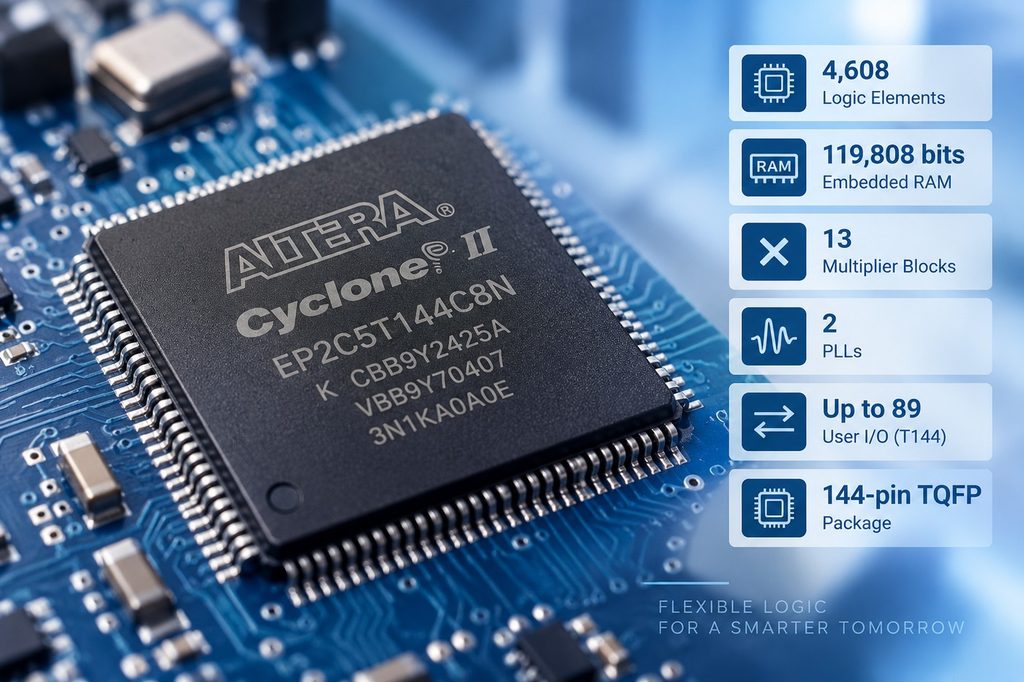
The EP2C5T144C8N pinout contains user I/O, power, ground, clock, configuration, JTAG, reference, and dual purpose pins. The 144 package pins should never be treated as 144 interchangeable GPIO connections.
The official EP2C5 pin information separates pins by I/O bank, VREF group, primary function, optional function, configuration function, and physical package pin number. The T144 pin column must be used for this ordering code.
The main groups are:
- User I/O: Connect external digital signals to programmable FPGA logic.
- VCCIO: Supplies the output drivers and selected input buffers in each I/O bank.
- VCCINT: Supplies the internal logic array at 1.2 V.
- Ground: Connects the FPGA power and signal return paths.
- Clock pins: Feed the dedicated clock network and PLL resources.
- MSEL and configuration pins: Determine configuration behavior during startup.
- JTAG pins: Support programming, device access, and boundary scan.
- VREF pins: Provide reference voltages when voltage referenced I/O standards are used.
- Dual purpose pins: Perform configuration functions during startup and may become user signals afterward.
A pin assignment should therefore be checked in three places: the PCB schematic, the Quartus pin report, and the official T144 pin list. If those three do not agree, the board should not be released based only on the package name.
Which EP2C5T144C8N Pins Require Special Attention?
Several pin groups can stop the FPGA from configuring or create electrical conflicts if they are handled incorrectly.
- VCCINT: Must be connected to the required 1.2 V core supply.
- VCCIO: Must match the I/O standard assigned to that bank.
- VREF: Required when the selected voltage referenced I/O standard uses a reference input.
- Dedicated clock pins: Should match the original clock architecture and Quartus assignments.
- MSEL pins: Select the configuration scheme used when the board starts.
- nCONFIG, nSTATUS, and CONF_DONE: These configuration signals affect startup and provide configuration status.
- JTAG pins: TCK, TMS, TDI, and TDO must remain correctly connected when JTAG programming or boundary scan is required.
- Dual purpose pins: Their startup behavior must be checked before using them as normal user I/O.
- Unused I/O: Their Quartus settings matter. Do not copy unused pin treatment from another FPGA family without checking the Cyclone II requirements.
Cyclone II supports different supply voltages across its I/O banks through the MultiVolt I/O architecture. VCCINT and VCCIO are separate power domains, and the bank voltage must be compatible with the I/O standards used on that bank.
This becomes especially important when replacing a device or recreating an older PCB. A correct physical pin number is not enough if the bank voltage or assigned electrical standard is wrong.
What Package Does the EP2C5T144C8N Use?
The T144 code identifies a 144 pin TQFP package. Altera specifies a 0.50 mm lead pitch, a 20 mm body, and approximately 22 mm overall package dimensions for the 144 pin TQFP. The lead free version uses matte tin lead finish.
For mature stock, check:
- Bent leads
- Lead coplanarity
- Oxidation or contamination
- Solder residue
- Package surface condition
- Marking consistency
- Tray and packaging condition
The visible leads make inspection easier than with a BGA package, but assembly condition still matters. A correct ordering code does not automatically mean a stored component is ready for production.
What Are the Common Applications of EP2C5T144C8N?
EP2C5T144C8N is most useful where a design needs moderate programmable logic together with embedded memory, multiplier resources, configurable I/O, and clock management.
- Industrial control: The programmable logic can implement deterministic state machines, sequencing, counters, timing logic, and parallel control interfaces without relying on software execution timing.
- Interface bridging: Configurable I/O and custom logic make the FPGA useful when two devices use different control signals, data widths, timing requirements, or communication logic.
- Data acquisition: M4K memory can buffer data while FPGA logic handles sampling control, data formatting, parallel capture, or transfer timing.
- Embedded systems: The device can move custom peripheral logic away from a processor, allowing the processor to focus on higher level software tasks.
- Arithmetic processing: The 13 embedded multiplier blocks can support suitable arithmetic operations without implementing every multiplication function in general logic.
- Existing equipment: One of the strongest reasons to continue using EP2C5T144C8N is compatibility with hardware that is already designed, programmed, tested, and qualified around Cyclone II.
For a new design, the older software environment and component lifecycle should be considered. Cyclone II requires the legacy Quartus II environment, with Altera listing 13.0sp1 as the latest supporting version.
For an existing product, however, moving to another FPGA can create new PCB, HDL, configuration, timing, testing, and certification work. The total redesign cost can matter more than the FPGA unit price.
What Should You Check Before Replacing EP2C5T144C8N With Another FPGA?
A replacement cannot be approved by comparing logic element count alone. Same family, same package, or higher logic capacity does not automatically mean direct compatibility.
| Area | What to Verify |
|---|---|
| Package | T144 footprint and physical dimensions |
| Pin assignments | Every used signal and dedicated pin |
| I/O banks | Bank locations and VCCIO |
| I/O standards | Voltage and interface compatibility |
| Core power | Supply voltage and power requirements |
| Logic resources | Actual Quartus utilization |
| RAM | M4K memory requirement |
| Multipliers | Arithmetic resource usage |
| PLLs | Clock generation and phase requirements |
| Timing | Existing timing constraints |
| Configuration | MSEL settings and configuration source |
| Software | Quartus project and device support |
Three replacement mistakes are especially common:
- Same T144 package does not mean the same pin assignments. Another device may use the same physical package while reserving or assigning pins differently.
- More logic does not mean timing compatibility. The design still has to compile and meet the original timing constraints.
- Electrical compatibility does not guarantee project compatibility. The Quartus device target, PLL setup, memory resources, configuration options, and programming file may need changes.
If you are considering a substitute because EP2C5T144C8N is difficult to source, compare the cost of the new FPGA with the cost of PCB modification, HDL migration, configuration changes, timing validation, production testing, and product qualification.
For many existing products, continuing to source the approved FPGA can be less disruptive than redesigning around a newer part.
What Should You Confirm Before Placing an EP2C5T144C8N Order?
Before approving an order, confirm the requirement against the full BOM entry.
- Exact ordering code: EP2C5T144C8N
- Package: T144
- Temperature grade: Commercial
- Speed grade: 8
- Material version: Lead free
- Quantity
- date code requirement
- Single lot or mixed lot requirement
- Packaging condition
- Inspection requirement
- Testing requirement
- Substitution policy
If the package, temperature grade, or speed grade must not change, state no substitution clearly in the RFQ.
The full ordering code matters because Cyclone II ordering information uses separate characters for the package, temperature range, speed grade, and lead free version.
How Can You Identify Counterfeit or Remarked EP2C5T144C8N Parts?
No single inspection method proves authenticity by itself. The strongest review combines traceability, marking inspection, package inspection, internal inspection, and electrical or functional verification according to the risk of the order.
- Part number and label review: Compare the ordering code, lot information, date code, quantity, labels, and device markings. Differences between documents and physical material should be resolved before release.
- Visual inspection: Check marking font, alignment, surface texture, package geometry, lead finish, scratches, resurfacing, coating, and other physical inconsistencies. Visual inspection is useful for screening, but a clean appearance alone does not prove authenticity.
- Lead inspection: Look for bent leads, oxidation, solder residue, unusual plating, or signs that the device may have been mounted or handled previously.
- Packaging review: Check trays, labels, sealing condition, quantity, and lot identification. If a supplier claims one lot, request evidence tied to the actual quantity being offered rather than relying only on website inventory.
- X Ray inspection: X Ray can compare die location, internal construction, bond structures, and consistency across samples. It can reveal internal differences that external inspection cannot, but it should still be interpreted together with other evidence.
- Decapsulation: Decapsulation exposes the die for deeper inspection when the risk justifies destructive testing. Die markings and internal construction can be compared with known or expected device characteristics.
- Functional testing: Define the test coverage before ordering. A basic electrical test may confirm that the device powers up, while a more meaningful FPGA test may check configuration, JTAG access, selected I/O, clock behavior, or programmed functions.
A production quantity for a critical product may justify more inspection than a small prototype order. The test scope and acceptance criteria should be agreed before shipment, not after a problem appears on the assembly line.
What Information Should Be Included in an EP2C5T144C8N RFQ?
A clear RFQ makes both stock verification and quote comparison more useful because each supplier is working from the same requirement.
Include:
- Part number: EP2C5T144C8N
- Quantity
- date code requirement
- Delivery location
- Required delivery date
- Single lot or mixed lot requirement
- Packaging requirement
- Inspection requirement
- Testing requirement
- Traceability requirement
- No substitution, if required
For the first availability check, quantity + date code requirement + delivery location are enough to start.
Before approving the order, confirm the remaining conditions. Two quotes with the same model number are not directly comparable if one refers to mixed lots with basic visual inspection and the other refers to a verified lot with additional testing and traceability.
Why Source EP2C5T144C8N Through Melson Components?
When EP2C5T144C8N is already on an approved BOM, the practical question is whether the available material meets your lot, quality, inspection, traceability, and delivery requirements.
Melson Components supports buyers in several areas:
- Free BOM Health Check: Review EOL, LTB, lead time, and availability risks before they interrupt production.
- In House Test Lab: Inspection support includes visual inspection, X Ray, decapsulation, LCR testing, and functional testing when required by the agreed inspection plan.
- X Ray Verified Inspection: X Ray provides additional internal evidence when external marking and packaging checks are not sufficient.
- 15 Year Traceability Records: RFQ, sourcing, inspection, packing, and shipment records can be retained for up to 15 years for later procurement or quality review.
- Controlled AVL Supplier Network: Controlled sourcing channels and qualified suppliers help reduce exposure to poorly documented supply sources.
- EOL and Alternative Support: When availability becomes difficult, sourcing options for obsolete components and possible alternatives can be reviewed. Any replacement still requires engineering approval before substitution.
- 20+ Years of Industry Foundation: Melson’s sourcing capability is supported by long term experience in electronic component procurement and supply support.
For procurement teams, this allows an offer to be evaluated using price, actual lot information, inspection scope, traceability, packaging, and delivery conditions together, rather than choosing only by the lowest unit price.
FAQs About EP2C5T144C8N
Q1: Does EP2C5T144C8N keep its configuration after power is removed?
A1: No. Cyclone II uses volatile SRAM configuration memory, so configuration data is lost when power is removed. The FPGA must be configured again after startup.
Q2: Can EP2C5T144C8N be programmed repeatedly?
A2: Yes. Because its operating configuration is stored in SRAM, the FPGA can be configured again with a different design. Reconfiguration does not permanently store that design in the FPGA’s configuration SRAM.
Q3: Can EP2C5T144C8N work with 3.3 V logic?
A3: Yes, when the selected I/O standard and bank configuration support it. VCCINT remains 1.2 V, while the appropriate VCCIO bank can operate at 3.3 V when the required I/O standard allows it.
Q4: Why does a design loaded through JTAG disappear after a power cycle?
A4: JTAG loads the FPGA configuration into volatile SRAM. When power is removed, the configuration disappears. The system must load the FPGA again from JTAG or another supported configuration source when it starts.
Q5: Which Quartus version supports Cyclone II?
A5: Altera currently lists Quartus II 13.0sp1 as the latest supported Quartus version for Cyclone II. Keeping a compatible installation together with the original project is useful when maintaining older equipment.
Q6: What is the difference between EP2C5 and EP2C5A?
A6: The A variant indicates a Cyclone II device option with faster power on reset behavior. The exact ordering code should still be checked before changing the FPGA in an existing product.
Q7: Can you recover the original FPGA pin assignments from the datasheet?
A7: No. The official pin information shows which functions are available on each physical pin, but it does not show which signals your product assigned to those pins. You need the original Quartus project, pin report, or design records to recover the board specific assignments.
Q8: Can the existing programming file be reused after replacing a failed EP2C5T144C8N?
A8: If the replacement is the same approved ordering code and the surrounding hardware has not changed, the existing configuration file can normally remain applicable. Confirm the target device, configuration method, and production programming process before release.
If EP2C5T144C8N is already on your BOM, send the quantity, date code requirement, and delivery location. Include requirements for single lot supply, packaging, X Ray inspection, decapsulation, functional testing, or traceability before order approval.
For EP2C5T144C8N sourcing and lot verification, contact Melson Components via sales@melsonchip.com. Clear RFQ and acceptance requirements make it easier to compare available material and reduce procurement risk before the components enter production.