 English
 中文
 english


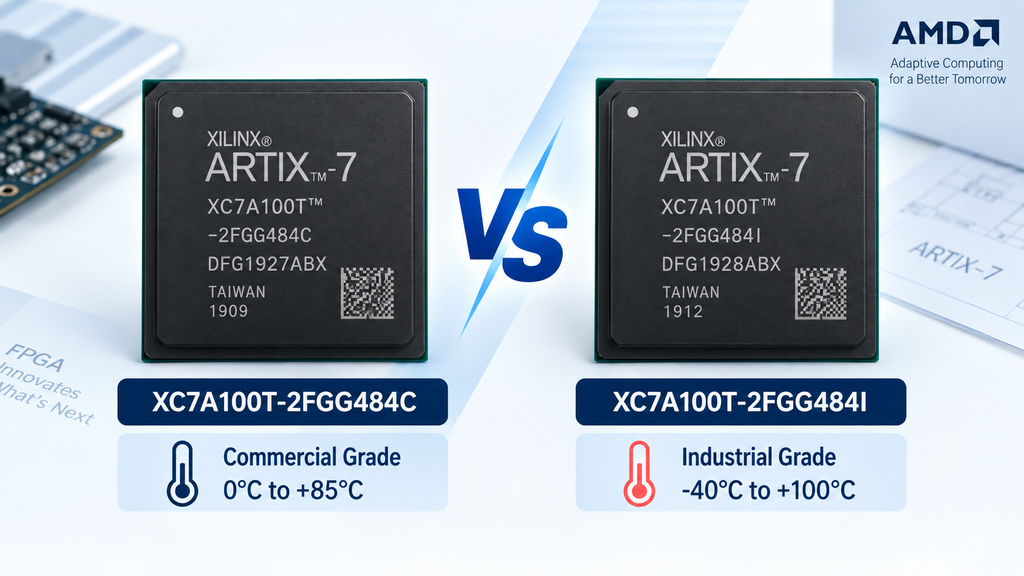
XC7A100T-2FGG484C and XC7A100T-2FGG484I are both AMD/Xilinx Artix-7 XC7A100T FPGAs with a -2 speed grade and FGG484 package. Their main difference is the temperature grade: C identifies the commercial-grade version, while I identifies the industrial-grade version.
This difference matters when selecting a device for a new design or reviewing a possible BOM substitution. The two parts share the same FPGA resources, package, speed-grade designation, and FGG484 pinout, but their specified junction-temperature ranges are different. A package-compatible part is therefore not automatically an approved replacement.
This comparison covers the specifications that change, the specifications that remain the same, whether the two versions can replace each other, and what engineers and buyers should verify before ordering.
What Is the Difference Between XC7A100T-2FGG484C and XC7A100T-2FGG484I?
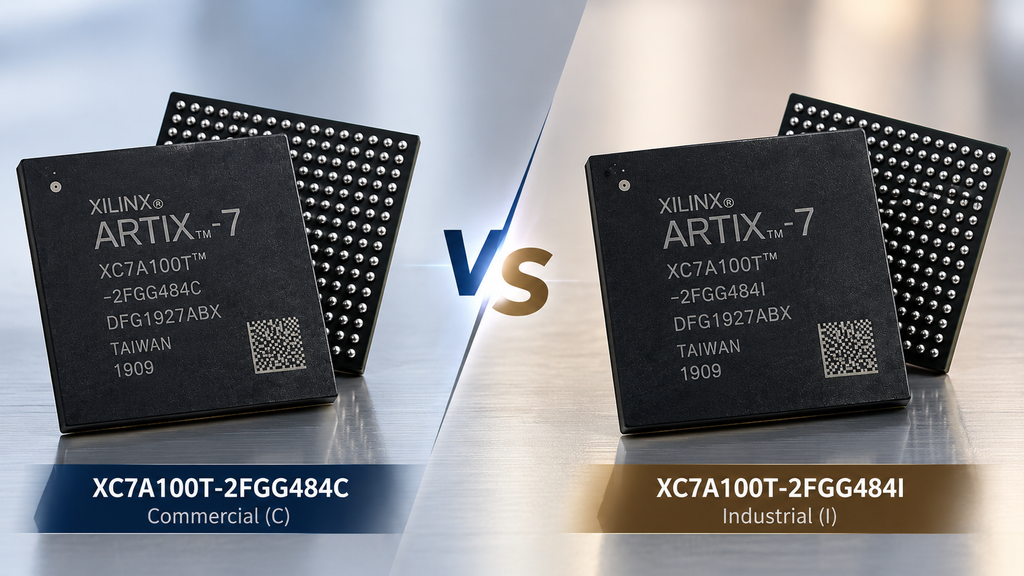
The difference is in the last character of the ordering code. XC7A100T-2FGG484C uses the commercial C temperature grade, while XC7A100T-2FGG484I uses the industrial I temperature grade.
Both versions retain the XC7A100T device, -2 speed grade, and FGG484 package. The C-grade device is specified for a junction-temperature range of 0°C to +85°C, while the I-grade version extends that range to -40°C to +100°C.
| Specification | XC7A100T-2FGG484C | XC7A100T-2FGG484I |
|---|---|---|
| FPGA family | Artix-7 | Artix-7 |
| Device | XC7A100T | XC7A100T |
| Logic cells | 101,440 | 101,440 |
| CLB slices | 15,850 | 15,850 |
| DSP48E1 slices | 240 | 240 |
| Maximum block RAM | 4,860 Kb | 4,860 Kb |
| Speed grade | -2 | -2 |
| Package | FGG484 | FGG484 |
| Maximum user I/O | 285 | 285 |
| Temperature grade | Commercial | Industrial |
| Junction-temperature range | 0°C to +85°C | -40°C to +100°C |
| Main selection factor | Commercial-temperature requirement | Wider industrial-temperature requirement |
The C or I suffix does not change the XC7A100T device resources. The difference matters mainly when the design, qualification specification, or BOM requires a particular operating-temperature grade.
What Do the C and I Temperature Grades Mean for XC7A100T?
In XC7A100T-2FGG484C, the final C means commercial temperature grade. The specified device junction-temperature range is 0°C to +85°C.
In XC7A100T-2FGG484I, I means industrial temperature grade, extending the specified junction-temperature range to -40°C to +100°C.
These figures refer to junction temperature, not simply ambient temperature. The temperature inside the FPGA can rise above the surrounding air temperature because of device power dissipation. FPGA utilization, airflow, PCB thermal design, enclosure conditions, and cooling all affect the final junction temperature.
For example, a system operating in a 70°C ambient environment cannot automatically be assumed to be suitable for XC7A100T-2FGG484C. If internal power dissipation pushes the FPGA junction above 85°C, the commercial-grade limit would be exceeded.
The device should therefore be selected from the expected thermal conditions of the complete system. The I-grade version becomes relevant when the design requires low-temperature startup, higher maximum junction temperature, or a wider qualified thermal range.
Which Specifications Are the Same Between XC7A100T-2FGG484C and XC7A100T-2FGG484I?
The two parts share most of the specifications represented by their ordering codes. Both are XC7A100T Artix-7 FPGAs, both carry the -2 speed-grade designation, and both use the FGG484 package.
Their programmable resources are also the same. The XC7A100T device provides 101,440 logic cells, 15,850 CLB slices, 240 DSP48E1 slices, and up to 4,860 Kb of block RAM. Changing from C to I does not increase or reduce these resources.
The same applies to the -2 designation. XC7A100T-2FGG484I is not a higher-speed version of XC7A100T-2FGG484C. Both are -2 devices. The final C or I identifies the temperature grade rather than another FPGA speed grade.
For substitution purposes, the part number can be read as follows:
XC7A100T = same FPGA device
-2 = same speed-grade designation
FGG484 = same package
C / I = different temperature grade
This distinction is useful when a buyer receives an alternate quotation that differs only in the last character of the full manufacturer part number.
Do XC7A100T-2FGG484C and XC7A100T-2FGG484I Use the Same FGG484 Package and Pinout?
Yes. Both parts use the XC7A100T device in the FGG484 package, so changing only the C/I temperature suffix does not change the package or FGG484 ball assignment.
The XC7A100T FGG484 package is a 23 mm × 23 mm BGA package with a 1.0 mm ball pitch and supports up to 285 user I/Os. The same package definition applies to both temperature grades.
This means that moving between XC7A100T-2FGG484C and XC7A100T-2FGG484I does not normally require a different PCB footprint solely because of the C/I suffix. The relevant XC7A100T FGG484 package and pinout remain the same.
However, same footprint and pinout do not by themselves approve a substitution. The required temperature grade, BOM status, project qualification, customer requirements, and complete ordering code still need to be checked.
This distinction is especially important when sourcing shortages lead to offers for the same XC7A100T FGG484 FPGA with a different temperature suffix.
Are XC7A100T-2FGG484C and XC7A100T-2FGG484I Interchangeable?
The two devices are package- and pinout-compatible, but the two substitution directions are not equivalent.
If XC7A100T-2FGG484C is specified, XC7A100T-2FGG484I may be technically suitable because it retains the same FPGA device, -2 speed grade, FGG484 package, and pinout while supporting a wider specified junction-temperature range. The change still needs to be accepted by the applicable BOM, engineering approval, qualification procedure, or customer specification.
Replacing XC7A100T-2FGG484I with XC7A100T-2FGG484C requires greater caution. If the design depends on the industrial version’s -40°C to +100°C junction-temperature range, the commercial version does not provide the same temperature coverage.
| Substitution Direction | Device/Package Compatibility | What Must Be Checked |
|---|---|---|
| XC7A100T-2FGG484I replaces XC7A100T-2FGG484C | Same device, -2 grade, FGG484 package, and pinout | BOM approval, qualification, customer requirements |
| XC7A100T-2FGG484C replaces XC7A100T-2FGG484I | Same device, -2 grade, FGG484 package, and pinout | Whether the narrower 0°C to +85°C range still meets the design requirement |
If the approved BOM specifies no substitution, the exact C or I version should be sourced regardless of package compatibility.
When Should You Choose XC7A100T-2FGG484C or XC7A100T-2FGG484I?
The choice should be based on required junction-temperature range, thermal margin, qualification requirements, and BOM control, rather than assuming that one version is generally better than the other.
Choose XC7A100T-2FGG484C when the system has been designed and validated within the commercial-grade temperature range and no industrial-temperature qualification is required. The important point is not whether the finished product is used indoors, but whether the FPGA junction temperature remains within its specified range under the worst expected operating conditions.
Choose XC7A100T-2FGG484I when the design must support a wider temperature range, including operation below 0°C or junction temperatures above the commercial-grade limit. This may apply to equipment with cold-start requirements, outdoor electronics, industrial systems, or enclosed products with greater internal thermal variation.
| Selection Factor | XC7A100T-2FGG484C | XC7A100T-2FGG484I |
|---|---|---|
| Required junction-temperature range | 0°C to +85°C | -40°C to +100°C |
| Project specification | Commercial grade accepted | Industrial grade required |
| Low-temperature operation | Not required below 0°C | May require operation below 0°C |
| High-temperature margin | Junction temperature remains below +85°C | Wider high-temperature range required |
| BOM | C-grade OPN specified | I-grade OPN specified |
An “industrial” product does not automatically require the I version. Likewise, a product operating indoors should not automatically be assigned the C version. The actual thermal and qualification requirements should determine the choice.
What Should You Verify Before Approving a C-to-I or I-to-C Substitution?
Start any substitution check with the complete manufacturer part number. XC7A100T-2FGG484C and XC7A100T-2FGG484I differ by only one character, but that character identifies a different qualified temperature range.
Before approving the change, verify:
- Device: Confirm that both parts are XC7A100T rather than another Artix-7 density.
- Speed grade: Make sure the approved requirement remains -2.
- Package: Confirm FGG484 and do not confuse it with another XC7A100T package.
- Pinout: Check the official XC7A100T FGG484 package and pinout information.
- Temperature requirement: Confirm whether the design requires C-grade or I-grade operation.
- Thermal margin: Check expected junction temperature under worst-case operating conditions.
- BOM and AVL status: Confirm whether another temperature grade is permitted.
- Qualification requirements: Determine whether the change requires engineering or customer approval.
- Received part identification: Verify the complete ordering code, device marking, and packaging information against the approved part.
Do not approve a different temperature grade simply because the specified version is unavailable. Availability can trigger a substitution review, but it should not replace the engineering and BOM approval process.
Which AMD Datasheets and Pinout Files Should You Check Before Ordering?
XC7A100T-2FGG484C does not require a completely separate technical document set from the I-grade version. The main specifications are covered by AMD’s Artix-7 and 7 Series documentation.
DS180 — 7 Series FPGAs Data Sheet: Overview
Use DS180 to confirm XC7A100T device resources, supported packages, speed grades, and available temperature-grade combinations.
DS181 — Artix-7 FPGAs Data Sheet: DC and AC Switching Characteristics
Use DS181 for recommended operating conditions, DC and AC characteristics, switching specifications, and the temperature limits associated with the C and I grades.
UG475 — 7 Series FPGAs Packaging and Pinout Product Specification
Use UG475 to verify the XC7A100T FGG484 package, ball assignments, I/O banks, power pins, configuration pins, and physical package information.
Artix-7 Package Device Pinout Files
Use the XC7A100T FGG484-specific pinout file during schematic, PCB, and substitution reviews instead of assuming that a 484-ball package automatically defines the required ball assignment.
Together, these documents cover the areas that matter most for this comparison: device resources, electrical limits, temperature grade, package, and pinout.
What Should Buyers Check When Sourcing XC7A100T-2FGG484C or XC7A100T-2FGG484I?
A sourcing error can occur when an RFQ specifies only XC7A100T-2FGG484 and leaves out the final C or I suffix. The FPGA device, -2 speed grade, and package may all appear correct while the offered part still has the wrong temperature grade.
Always use the complete manufacturer part number in the RFQ and state clearly whether another temperature grade is acceptable. Quantity, date-code requirement, packaging requirement, and delivery location should also be defined before stock is evaluated. If the approved BOM requires XC7A100T-2FGG484C specifically, state no substitution rather than leaving the temperature suffix open.
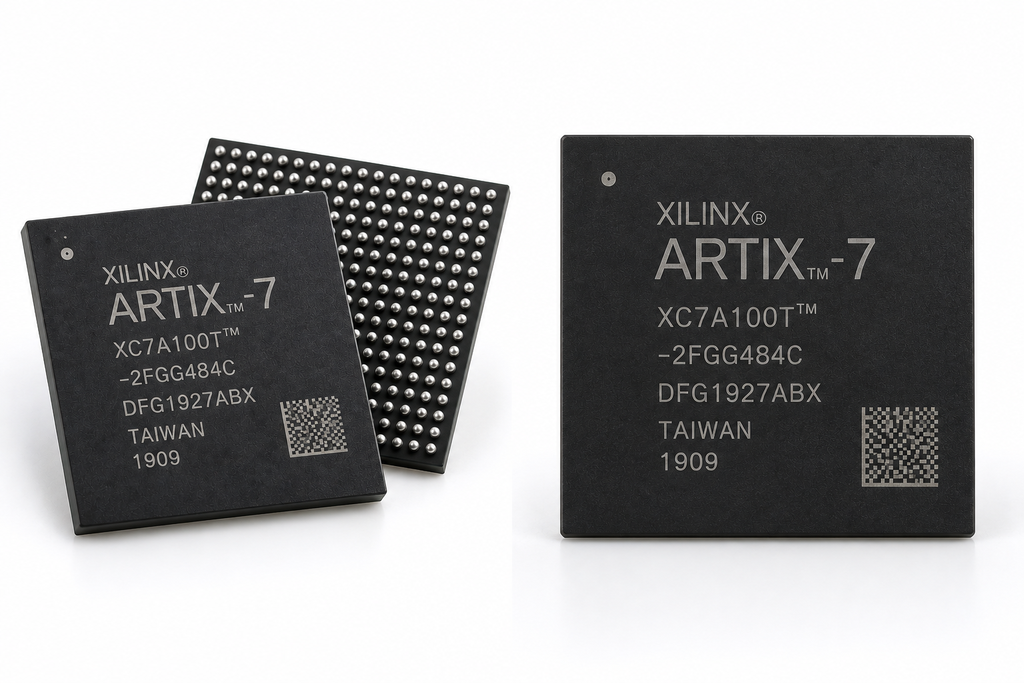
For available stock, compare the quotation, packaging label, device marking, date/lot information, and agreed traceability records with the requested OPN. A sourcing decision should confirm more than the XC7A100T family and FGG484 package; it should confirm the correct -2 speed grade and C or I temperature suffix.
Where additional verification is required, define the inspection and testing scope before shipment. Visual inspection, X-ray, De-Cap, or functional testing may be considered depending on the sourcing risk, project requirement, and agreed acceptance criteria.
For an XC7A100T-2FGG484C or XC7A100T-2FGG484I RFQ, send Melson Components the complete part number, quantity, date-code requirement, and delivery location to sales@melsonchip.com.
FAQs About XC7A100T-2FGG484C vs. XC7A100T-2FGG484I
Q1: Is XC7A100T-2FGG484C still commonly identified as a Xilinx part?
A1: Yes. The device originated under Xilinx and is now part of AMD’s FPGA portfolio, so buyers may see both AMD and Xilinx references in datasheets, distributor listings, labels, and older BOM records.
Q2: Should the final C or I suffix always be included in an RFQ?
A2: Yes. The suffix is part of the complete manufacturer part number. Omitting it can create ambiguity because XC7A100T-2FGG484C and XC7A100T-2FGG484I are different orderable variants.
Q3: What should I do if a supplier quotes XC7A100T-2FGG484 without the final suffix?
A3: Ask the supplier to confirm the complete OPN before approval. The quotation should clearly state whether the offered device is the C-grade or I-grade version.
Q4: Should all XC7A100T-2FGG484C parts in one order have the same date code?
A4: Not automatically. If same-date-code or same-lot supply is required, state it in the RFQ. A website stock quantity alone does not prove that all available parts come from the same lot or date code.
Q5: What photos are useful before buying XC7A100T-2FGG484C from an independent source?
A5: Request clear photos of the device top marking, inner packaging, outer box or tray label, and lot/date-code information. These help compare the quoted part with the physical stock before shipment.
Q6: Should XC7A100T-2FGG484C and XC7A100T-2FGG484I be mixed in the same production lot?
A6: Only if the project documentation explicitly allows both variants. If the BOM requires one exact OPN, mixed C- and I-grade parts should not be treated as equivalent stock.
Q7: What does “no substitution” mean when ordering XC7A100T-2FGG484C?
A7: It means the supplier should provide the exact requested manufacturer part number rather than offering another temperature grade, package, speed grade, or related XC7A100T variant without approval.
Q8: What information helps speed up an XC7A100T-2FGG484C RFQ?
A8: Send the complete part number, quantity, date-code requirement, delivery location, and any lot or packaging requirement at the start. This reduces back-and-forth when checking available stock.