 English
 中文
 english


The XC6SLX9-2FTG256I is a Xilinx Spartan-6 LX FPGA used in established industrial, communication, control, imaging, and embedded products. When the exact OPN is required, the main sourcing risks are incorrect suffixes, unclear stock, counterfeit or refurbished parts, older lots, and unapproved replacements.
Before ordering, check the specification, lifecycle status, actual stock, authenticity, lot condition, compatibility, and replacement risk rather than relying on price or an online inventory number alone.
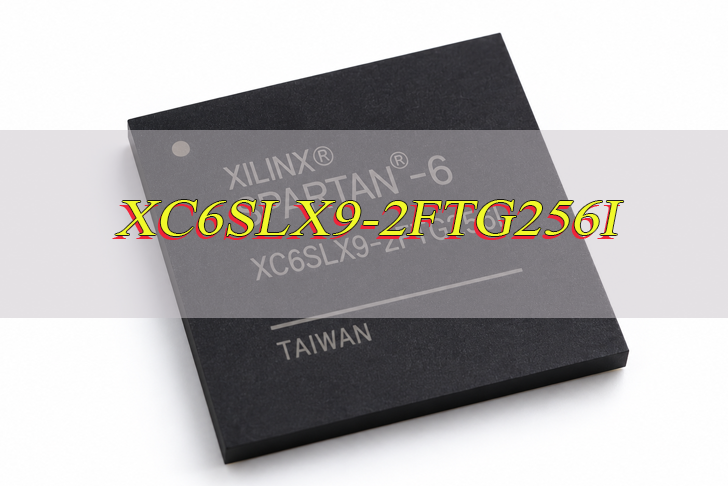
What Are the Main Risks When Sourcing XC6SLX9-2FTG256I?
Sourcing XC6SLX9-2FTG256I involves more than finding a supplier that lists the part number. Problems usually appear when the quoted material cannot be tied to the exact OPN, an identifiable lot, or a realistic shipment date.
Here are the main risks when sourcing XC6SLX9-2FTG256I:
- Wrong part suffix: A different speed grade, package, or temperature grade may not match the approved BOM.
- Unverified stock: A website quantity may refer to upstream inventory rather than physical stock ready to ship.
- Counterfeit or refurbished parts: Remarked, resurfaced, reballed, or recovered devices can appear in higher-risk supply channels.
- Unclear date code or lot: Mixed lots or older inventory may be offered without enough information for approval.
- Poor storage condition: Long-stored BGA devices may have moisture, packaging, or solderability concerns.
- Unapproved substitutes: A similar FPGA can still introduce timing, pinout, voltage, configuration, or PCB changes.
- Delivery uncertainty: Market availability does not always mean the devices can ship within the required schedule.
For a production order, the question is not only whether XC6SLX9-2FTG256I is available, but whether the exact material is identifiable, acceptable, and able to ship when needed.
Which XC6SLX9-2FTG256I Specifications Should You Check Before Buying?
Only a limited number of datasheet parameters directly affect procurement, but those parameters must match the approved design. The complete OPN, speed grade, package, temperature grade, and package-specific resources deserve the most attention.
Here are the main XC6SLX9-2FTG256I specifications to check before buying:
| Item | Specification |
|---|---|
| Manufacturer | Xilinx / AMD |
| Family | Spartan-6 LX |
| Device | XC6SLX9 |
| Logic cells | 9,152 |
| Speed grade | -2 |
| Package | FTG256 |
| Package type | 256-ball Pb-free BGA |
| Package size | 17 × 17 mm |
| Ball pitch | 1.0 mm |
| User I/O | 186 |
| Block RAM | 576 Kb |
| DSP48A1 slices | 16 |
| I/O banks | 4 |
| Temperature grade | Industrial |
| Junction temperature | -40°C to +100°C |
Below is a download link of XC6SLX9-2FTG256I datasheet for your review:
What Is the Current Lifecycle Status of XC6SLX9-2FTG256I?
Lifecycle status matters when the same FPGA must remain available for an existing product for several more years. AMD has stated that Spartan-6 product support extends through at least 2030, but that does not guarantee continuous availability of every individual order code.
Here are the lifecycle points to consider:
- Current manufacturer support: Check whether Spartan-6 remains within the stated support period.
- Remaining product life: Compare the FPGA lifecycle with how long the equipment must remain in production or service.
- Repeat demand: Estimate whether the same OPN will be needed for future builds, repairs, or maintenance.
- Supply pressure: Repeated shortages or longer lead times may appear before formal discontinuation.
- Migration timing: If the product will remain active beyond the current support horizon, consider a migration plan before supply becomes urgent.
Lifecycle status helps with long-term planning. It does not confirm whether a specific XC6SLX9-2FTG256I lot is available today.
How Can You Verify XC6SLX9-2FTG256I Stock and Lead Time?
Online inventory can help locate possible sources, but it should not be treated as confirmed stock until the supplier explains where the material is and when it can ship. For a time-sensitive build, physical inventory and market availability are not the same thing.
Here are the stock and lead-time details to verify:
- Confirm physical stock: Ask whether the quoted quantity is already in the supplier’s warehouse. Physical stock should have a specific quantity and be available for lot confirmation or inspection.
- Separate supply status: Determine whether the material is on hand, incoming, upstream stock, or still being sourced. On-hand inventory carries less delivery uncertainty than a market listing.
- Match the exact OPN: Make sure the available devices are XC6SLX9-2FTG256I. Inventory for another speed grade, package, or temperature suffix should not be counted as exact-part stock.
- Check who controls the material: If the quantity belongs to another distributor or upstream source, confirm whether it has already been reserved. Unsecured stock can disappear before the purchase order is placed.
- Confirm inspection status: Find out whether the material has already been received and inspected or whether verification will start only after sourcing is completed.
- Ask for the expected ship date: A general lead time may not include incoming inspection, additional testing, packing, export preparation, or logistics.
- Check quotation validity: Price and availability for older FPGA inventory can change quickly, so confirm how long the quoted quantity and delivery commitment remain valid.
The sourcing material for this device also separates on-hand stock, incoming stock, estimated sourcing quantities, and factory or authorized-channel lead time.
For urgent requirements, focus on controlled quantity, inspection status, and shipment date rather than the largest stock figure shown online.
How Can You Identify Counterfeit or Refurbished XC6SLX9-2FTG256I Parts?
Counterfeit or refurbished FPGA parts are rarely exposed by one obvious defect. A more reliable check compares the device marking, package condition, source information, and inspection results to determine whether they are consistent with the material being sold.
Here are the main checks for counterfeit or refurbished XC6SLX9-2FTG256I parts:
- Compare device markings: Check the manufacturer logo, complete OPN, font, spacing, alignment, and marking position. Unexplained differences within one claimed lot should be investigated.
- Look for resurfacing or remarking: Sanding marks, uneven texture, unusual coating, blurred characters, or inconsistent printing can indicate that the package surface has been altered.
- Inspect the BGA balls: Irregular ball shape, inconsistent finish, solder residue, or reballing traces may indicate previous assembly or recovery from used equipment.
- Check the package condition: Scratches, contamination, chipped edges, or unusual wear deserve closer review when devices are being sold as new material.
- Compare labels with the devices: The OPN, date code, and lot information on trays or outer packaging should agree with the devices inside.
- Use X-ray when the sourcing risk is higher: X-ray can reveal package-level or internal differences that are not visible externally.
- Add electrical or functional testing when needed: Sample testing adds another layer of evidence for independently sourced or higher-value lots.
- Use de-cap selectively: Destructive analysis can be useful for disputed or higher-risk material, but it should follow an agreed sampling plan.
One test is not enough to establish the history of an entire lot. Source records, markings, physical inspection, X-ray, and functional results provide stronger evidence when reviewed together.
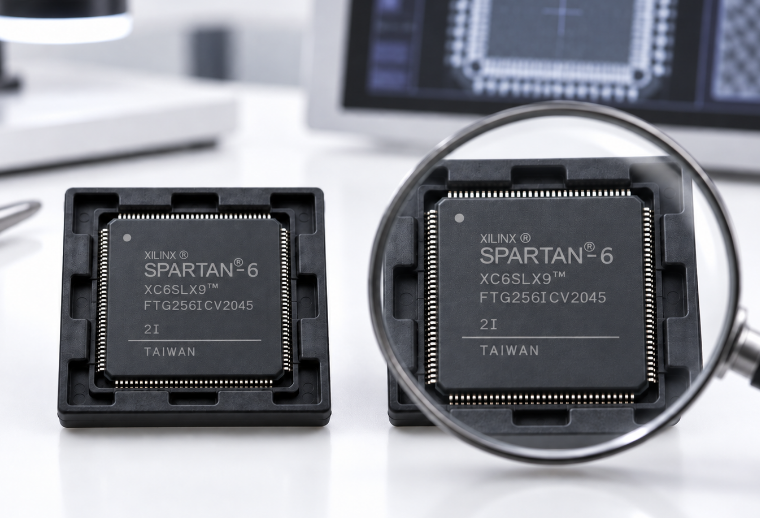
What Should You Check About Date Code, Lot, Packaging, and Storage Condition?
An older date code does not automatically make XC6SLX9-2FTG256I unsuitable for production. The more useful question is whether the actual lot has been identified, packaged, stored, and handled well enough to meet the assembly and purchasing requirements.
Here are the date code, lot, packaging, and storage details to check:
- Confirm the actual date code: Avoid vague descriptions such as “recent DC.” Ask for the specific date code tied to the offered material.
- Check whether the quantity is single-lot or mixed-lot: A large stock position may contain several manufacturing lots. If one lot is required, specify that before sourcing.
- Define the accepted date code range: Decide the allowable date code before the supplier reserves material rather than after the shipment arrives.
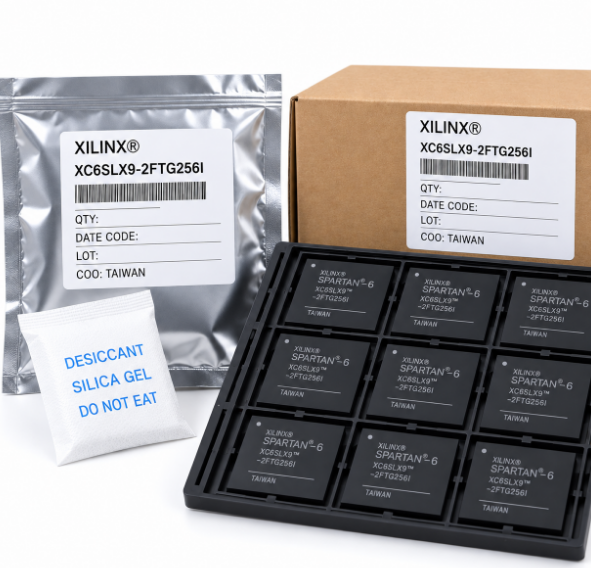
- Confirm original or repacked condition: Ask whether the devices remain in original packaging or have been transferred to different trays.
- Check moisture protection: Review moisture-barrier packaging, desiccant, and humidity indicators where applicable.
- Review available storage information: Older BGA inventory deserves closer attention when the packaging has been opened or storage history is unclear.
- Set packaging requirements in advance: If original trays or factory-sealed packaging are required, include that condition in the RFQ.
Date code should not be used as the only acceptance criterion. Lot consistency, packaging condition, moisture control, and storage history are equally relevant when evaluating older inventory.
What Compatibility Problems Should You Check Before Ordering XC6SLX9-2FTG256I?
Compatibility should be checked whenever a supplier offers a different suffix or a similar Spartan-6 device. Even a closely related FPGA may differ in package, temperature grade, timing, power, or configuration requirements.
Here are the main compatibility points to check before ordering:
- Package and pinout: Confirm the FTG256 package, PCB footprint, ball assignment, power pins, configuration pins, and user I/O match the existing board.
- Speed grade: XC6SLX9-2FTG256I uses the -2 speed grade. A different grade should be reviewed against the approved timing requirements before substitution.
- Temperature grade: The I suffix identifies the industrial-temperature version. A commercial-grade variant should not be used unless the operating environment and qualification requirements allow it.
- Power and I/O voltage: Check the core, auxiliary, and I/O supply requirements, including the voltage used by each I/O bank.
- Timing and clocking: Make sure the replacement still meets the required clock frequencies, setup/hold margins, and interface timing.
- Configuration and design files: Confirm the configuration method, bitstream, FPGA project, and development-tool compatibility. A different device may require the design to be rebuilt and retested.
- Device resources: Check that the proposed FPGA provides the logic, block RAM, DSP resources, and package-specific I/O used by the existing design.
For example, XC6SLX9-2FTG256C may look very similar to XC6SLX9-2FTG256I, but the temperature grade is different. A different speed grade may also require timing review even when the package remains the same.
If the offered device is not the exact XC6SLX9-2FTG256I, do not approve it based on part-number similarity alone. The proposed replacement should be reviewed against the existing BOM and design requirements before the order is released.
Can an Alternative FPGA Replace XC6SLX9-2FTG256I?
An alternative FPGA may help when supply is limited, but the engineering effort increases as the proposed device moves further away from XC6SLX9-2FTG256I. The closest qualified variant is normally the first option to evaluate.
Here are the main replacement routes:
- Another XC6SLX9 speed grade: May be possible after timing and qualification review.
- Another XC6SLX9 temperature grade: Suitable only if the required operating-temperature range allows it.
- Another Spartan-6 device: Package, resources, power, configuration, and design compatibility need to be checked.
- Spartan-7 or Artix-7: Normally requires design migration rather than a simple component substitution.
For an established product, continuing to source the exact XC6SLX9-2FTG256I may involve less disruption than redesigning the PCB and requalifying the system. Newer FPGA families should be treated as redesign candidates rather than automatic replacements.
What Information Should You Include in an XC6SLX9-2FTG256I RFQ?
A clear RFQ helps prevent unsuitable material from being quoted in the first place. Define the purchasing conditions at the start so the supplier knows what quantity, date code, lot, packaging, and delivery conditions are acceptable.
Here is the information to include in an XC6SLX9-2FTG256I RFQ:
- Exact OPN: XC6SLX9-2FTG256I
- Quantity
- Required delivery date
- Delivery location
- Date code requirement
- Single-lot or mixed-lot requirement
- Packaging requirement
- Required sourcing or traceability documents
- Inspection or testing requirement
- Whether independent-channel material is acceptable
- Whether alternatives may be proposed
If the exact OPN is required, state that clearly. Any alternative should be quoted separately rather than mixed into the XC6SLX9-2FTG256I offer.
Why Choose Melson Components for XC6SLX9-2FTG256I Sourcing?
When XC6SLX9-2FTG256I becomes difficult to source, the value of a supplier is reducing the chance of receiving questionable stock, losing time on a rejected lot, or discovering a supply problem after production has already been scheduled.
Here is how Melson Components helps reduce those sourcing risks:
- Reduce counterfeit and refurbished-part risk: Melson’s in-house test lab supports visual inspection, X-ray, de-cap, LCR, and functional testing when additional verification is required.
- Know what material you are buying: Date code, lot information, inspection, packing, and shipment records can be tied back to the sourcing process rather than treating every market listing as equivalent.
- Keep records available for later review: RFQ, sourcing, inspection, packing, and shipment records can be retained for up to 15 years, supporting repeat purchases and later quality investigations.
- Reduce exposure to questionable sources: A controlled AVL supplier network helps screen supply channels when normal distribution inventory is limited.
- Find supply problems earlier: A BOM health check can identify EOL, LTB, lead-time, and availability risks before one component delays the build.
- Handle shortage and EOL requirements without hiding substitution risk: Melson can source difficult-to-find or obsolete components and identify possible alternatives, while replacement approval remains separate from the sourcing decision.
- Draw on established component-sourcing experience: Melson has 20+ years of industry experience, which is particularly useful when an established FPGA is harder to obtain through normal channels.
These capabilities are most useful when the requirement involves older stock, short lead times, independent sourcing, strict date codes, or a production schedule that cannot absorb a rejected lot.
FAQs About XC6SLX9-2FTG256I Procurement
Q1. Is XC6SLX9-2FTG256I obsolete?
A1. AMD states that Spartan-6 support extends through at least 2030. Exact XC6SLX9-2FTG256I availability still needs to be checked separately.
Q2. Is XC6SLX9-2FTG256I still available?
A2. Availability changes with quantity, date code, and supply channel. Confirm current stock through a dated quotation rather than relying on a static online quantity.
Q3. What does FTG256 mean?
A3. FTG256 identifies the 256-ball Pb-free BGA package used by this device.
Q4. What does the I suffix mean?
A4. The I suffix identifies the industrial temperature grade, specified for a junction-temperature range of -40°C to +100°C.
Q5. Can XC6SLX9-2FTG256C replace XC6SLX9-2FTG256I?
A5. Not automatically. The C and I suffixes represent different temperature grades, so operating and qualification requirements must be checked first.
Q6. Does an older date code mean the FPGA is counterfeit?
A6. No. Date code alone does not determine authenticity. Lot information, packaging, storage history, source information, and inspection results also matter.
Q7. How can I verify whether XC6SLX9-2FTG256I stock is real?
A7. Confirm the physical quantity, exact OPN, supply status, stock location, inspection status, and expected ship date.
Q8. What are common signs of refurbished XC6SLX9-2FTG256I parts?
A8. Check for resurfacing, remarking, reballing, solder residue, unusual wear, inconsistent markings, and label mismatches.
Q9. Is X-ray enough to verify XC6SLX9-2FTG256I authenticity?
A9. No. X-ray is one part of verification and should be considered together with source information, markings, physical inspection, and other testing where required.
Q10. Can another Spartan-6 speed grade replace the -2 version?
A10. It may be possible, but timing and qualification should be reviewed before the change is approved.
Q11. Can Spartan-7 directly replace XC6SLX9-2FTG256I?
A11. Generally no. Moving to Spartan-7 normally involves FPGA and PCB design migration rather than a simple purchasing substitution.
Q12. What information is needed for an XC6SLX9-2FTG256I quote?
A12. At minimum, provide the quantity, date code requirement, and delivery location. Add lot, packaging, inspection, or alternative requirements when they apply.
If you are sourcing XC6SLX9-2FTG256I, send us your quantity, date code requirement, and delivery location. Melson Components can review the available stock, relevant lot information, and delivery schedule and prepare a quotation based on your requirement. Send your inquiry to sales@melsonchip.com for a current XC6SLX9-2FTG256I quote.